tradition, modernity and global connectivity.
Sound of
Shanghai
The music & performance
Cultural Heritage
and Innovation,
uniting
Shanghai
as muse.
Does every city have its own sound? This foundational question lies at the heart of Marios Joannou Elia’s «Sound of» series. First presented in Berlin – where it was hailed as «a true form of audiovisual art that had never existed before» – the series has since evolved from «Sound of Vladivostok» to «Sound of Kyoto», and now reaches a new stage with «Sound of Shanghai». This initiative does not simply document urban life but redefines the epistemology of the urban soundscape, blending music, acoustic ecology, performative practice, and visual dramaturgy into a cohesive cinematic film concert.
Shanghai, a city of unparalleled dynamism, emerges as both object of study and artistic muse for this ambitious endeavor. As the world’s third-largest metropolis, it offers a unique convergence of tradition and modernity, where historical strata coexist with futuristic urban architectures. Revered as China’s gateway to the world, Shanghai epitomizes global connectivity and cultural innovation, making it an extraordinary locus for this polyphonic exploration.
«Sound of Shanghai» derives its evocative subtitle, «Opera of a Cosmopolis», from the dialectical interplay of past and present. Drawing inspiration from an ancient Kunqu melody in «The Peony Pavilion», rooted in the Jiangnan region, the project recontextualizes this heritage within a contemporary symphonic dialogue. Here, the city itself is transfigured into both instrument and stage, with its diverse spaces and soundscapes intricately woven into an immersive audiovisual narrative.
This project does more than celebrate Shanghai’s cultural identity – it magnifies it, transforming the metropolis into a living opera where historical memory intertwines with the rhythms of contemporary life. «Sound of Shanghai» thus captures the multifaceted essence of a city that continues to inspire and ignite creativity across the globe.
每座城市都有它独特的声音吗?这个问题是马里奥斯·乔安努·埃利亚(Marios Joannou Elia)《城市之声》系列项目的核心。 从《海参崴之声》到《京都之声》,这一系列作品不断突破自我,如今通过《上海之声》达到了新的高度。 在柏林首演时,《城市之声》被誉为“前所未有的视听艺术形式”。 它重新定义了都市环境的体验,将音乐、声音景观、表演艺术和视觉效果融为一体,呈现出一场独特的电影音乐会。
上海,这座充满活力与创意的城市,为这一宏大项目提供了源源不断的灵感。 作为全球第三大都市,上海完美地融合了传统与现代,让历史文化的底蕴与未来的天际线相互交织。 此外,上海被誉为中国通向世界的门户,不仅象征着全球联通与文化创新,还为这场多元化的艺术探索提供了绝佳的舞台。
《上海之声》的副标题“大都会的歌舞剧”,正是在这种传统与现代、过去与现在的交织中孕育而生。 项目从昆曲《牡丹亭》中的经典旋律汲取灵感,将这一源自江南地区的传统艺术形式与现代交响乐对话,赋予其新的生命力。 在这里,城市本身被转化为乐器与舞台,多样的空间与声景被精密编织成沉浸式的视听叙事。
此项目不仅礼赞上海独特的文化身份,更是对这座城市精神的深刻挖掘。 通过将上海悠久的历史与现代都市的节奏结合,《上海之声》呈现了这座城市的多维精髓, 不断激发全球的创造力与想象力。
Project in numbers.
musicians and performers
audio and video clips
audio tracks
locations
institutions involved
The Pillars
of the project.
The pillars of the project are four interwoven elements — new music inspired by the city, sounds drawn from its cultural and urban identity, performances staged in emblematic spaces, and cinematography that captures Shanghai’s pulse and kinetic energy.
Music
An instrumentarium where traditional voices meet European timbres, reflecting Shanghai’s unique role as a cultural crossroads.
–Guzheng Orchestra of the Shanghai Conservatory of Music (conductor: Yao Qi): Ensemble of 18 Guzheng and a Sheng, incorporating a Monophonic Choir.
–Jinqi Ruan Orchestra (conductor: Qiang Wu).
–Jazz Trio at Lincoln Center Shanghai.
–Chorus of the Shanghai Xiao Ke Dou Music Kindergarten.
–Chorus of Qipao Ladies (Shanghai Haipai Qipao Culture Promotion Association).
Sounds
Bund warning megaphones join culinary rituals, theatrical traditions, martial gestures, and futuristic technologies to shape Shanghai’s acoustic identity.
–Steaming teapot rhythms.
–Shadow theatre echoes.
–Huangpu ships and Zhujiajiao boat.
–Tai Chi fan and moon blade.
–Neural activity transformed into sound.
Performance & Spaces
A tapestry of site-specific performances across Shanghai’s emblematic locations transformed the city into a living stage.
–Bund and Nanjing Road.
–Zhujiajiao water town.
–Sijing ancient town.
–Shenyuan Garden.
Cinematography
A visual choreography where drones, timelapses, and computational techniques capture Shanghai’s urban pulse and kinetic energy.
–Hyperlapses and day-to-night timelapses.
–Dynamic tracking shots.
–Match-on-motion edits and layered transitions.
–Adaptive motion blur and dynamic speed control.
From score
to recording
to space.
loudspeakers
of WFS immersion
The art and
technology of
spatial audio
reproduction.
How was «Sound of Shanghai» built sonically?
This presentation moves from composer/context and a three-work analysis to an exploration of the venue’s acoustics and its planned renovations, including the integration of Wave Field Synthesis (WFS) spatial acoustic enhancement technology. It then delves into microphone topologies and track-specific recording strategies designed to achieve precise spatial capture.
Building on this foundation, it also addresses object-based WFS spatial audio production, examining its applications in cinematic sound presentation, Full Dimension spatial audio systems, and site-specific sound installations. Altogether, the presentation highlights how the convergence of music, technology, and spatial design shapes new frontiers in immersive auditory experience and artistic expression.
Spatial Capture Precision
0%Venue Acoustic Optimization
0%AI-Assisted Sound Mapping
0%Microphone Topology Accuracy
0%Post-production Integration Efficiency
0%Spatial Audio Architecture
A fusion of art, acoustics, and AI, the project advances spatial audio practice through a Wave Field Synthesis environment of 640 loudspeakers (40 wall-mounted + 10 dual-layer ceiling modules) and an AI-driven, real-time field controller that sculpts the room’s sonic architecture.
Purpose-built microphone topologies — 8 suspended 3D overheads, 3 PZM ground points, and tailored spots (RN17, VR1/VR2, RNT, V7) — deliver hyper-accurate localization and timbral fidelity.
Mixed in Dolby Atmos 9.1.6 and IMF (IOSONO), the object-based pipeline restores instruments to their XYZ coordinates, enabling a poetic practice of spatial folding that merges venues, times, and listening dimensions.
wall-mounted + 10
dual-layer ceiling modules
individually addressable speakers
Documenting
the process
The accompanying photobook of «Sound of Shanghai: Opera of a Cosmopolis» emerges as an aesthetic document of multifaceted synthesis — part chronicle, part reflection, part revelation. It traces the resonance between music, architecture, and light as interdependent forces shaping perception and space. Through meticulously composed imagery, the volume unfolds the creative metamorphosis of an entire city becoming sound, image, and subject.
Far beyond a visual record, it functions as a meta-composition: a polyphonic encounter between the visible and the audible, the constructed and the imagined. In this way, the book extends the work’s artistic philosophy, transforming documentation into reflection, resonance, and luminous thought — a tribute to the intellectual and sensorial poetics of the «Sound of» concept.
News.
Reportages in Chinese
and other languages
that reveal aspects of the project.
«Sound of Shanghai: The Sound of Silk and Thread»
In this episode, Elia, creator of «Sound of Shanghai», meets Qian Yuefang – a national-level inheritor of Gu Embroidery.
SMG (Shanghai Media Group) City Channel · 上海之声:顾绣——丝与线的声音 · TV · Report · China
Sound as a Bridge Between Cultures
On Monday, December 30, 2024, at the China Welfare Institute Children’s Palace in Shanghai, Marios Joannou Elia spoke about «Sound of Shanghai – Opera of a Cosmopolis», inspiring young audiences through sound and creativity.
«Sound of Shanghai»: Launch and Public Discussion at Swatch Art Peace Hotel
On Thursday, November 14, 2024, at 5:00 p.m., the official launch of «Sound of Shanghai – Opera of a Cosmopolis» took place at the Swatch Art Peace Hotel in Shanghai.
Public Discussion · Bilingual (Chinese & English) · By Invitation Only · China
上海的声音
大都会的歌舞剧
Listening:
A manifesto
«Listening is the most human of verbs.»
In a world that speaks faster than it hears, «Sound of Shanghai» invites us to pause — not to understand, but to feel. To listen, not merely with the ear, but with presence.
A series of written reflections accompany the project, offering poetic and philosophical perspectives on its artistic vision and on the act of listening itself.
「聆听,是最具人性的动词。」
SMG电视
上海的声音
大都会的歌舞剧
Behind the Scenes of «Sound of Shanghai» - Gu Embroidery.
Carlo Giordanetti
CEO of the Swatch Art Peace Hotel (Shanghai)
Member of the Swatch Design Committee &
In charge of Swatch’s presence at the Venice Biennale
«The ‹Sound of Shanghai› – what an exciting title for an incredible work of art!»
Li Yang
Shanghai Municipal Administration of Culture and Tourism
Inheritance and Protection of Intangible Cultural Heritage
«An artistic journey that celebrates Shanghai’s cultural soul and connects it with the world.»
Professor Hao Liu
Shanghai Conservatory of Music
Director, Department of Chinese Traditional Music
«Through his unique musical vision,
Marios captures the essence of Shanghai —
allowing the world to hear the spirit of China.»
Huiting Shen
President, Shanghai Haipai Qipao Culture Promotion Association
«A harmonious blend of tradition and innovation,
revealing Shanghai’s rich heritage
through a distinctive and powerful aesthetic.»
Zhao Jinyu
China’s Cultural Ambassador for Kunqu Opera
Director, Shanghai Mengle Kunqu Opera Pengpai Art Study Center
«Created by Elia, the ‹Sound of Shanghai› is a landmark cultural project whose international visibility is significantly advanced through his ongoing artistic and scholarly work.»
From brainwaves to peonies —
where sound, light, and digital nature converge.
Reflex-in:
The Sonic Bloom
The Sound
In «Sound of Shanghai: Opera of a Cosmopolis», Marios Joannou Elia transforms neural activity into music through the «Reflex-in» installation — a system that converts brainwave streams into real-time sonic structures using EEG technology. His neural impulses shape the composition directly within the digital environment, turning thought into sound.
The Reflex-in system integrates advanced Web technologies such as Web Audio, WebSocket, WebAssembly, and WebGL to generate browser-based sound environments. Through algorithmic mapping, brainwave signals are translated into musical events, producing meditative and immersive soundscapes.
The process establishes a closed-loop dialogue between composer and system, expanding the creative possibilities of brain–computer musical interfaces.
The Light
Simultaneously, Elia operates an interactive light installation on the rooftop of the Swatch Art Peace Hotel, where hand gestures and motion tracking control dynamic lighting in real time. The system merges software and hardware components into a portable and customizable performance setup.
Through Ableton and Max plugins, audio responses, sensor data, and visual motion capture define the rhythm and intensity of the lights. A compact decoder box transmits and modulates signals between the control interface and the light fixtures, establishing a seamless dialogue between sound and illumination. The result is a living audiovisual composition — where neural energy, physical gesture, and light converge in real time.
The Peony
Drawing inspiration from the ancient melody of the «Peony Pavilion», the project reimagines the symbolism of the peony through a contemporary lens. The flower, once a metaphor for love and awakening, finds in this work a digital and sonic reincarnation — a dialogue between nature and technology, past and future, sound and vision.
These digital peonies are generated through photorealistic simulations using Blender’s geometry nodes. The system employs procedural animation and node-based motion parameters to depict the organic unfolding of petals — a process that mirrors Elia’s EEG-driven sound modulation. Together, they embody the notion of technological nature, exploring how human perception of the natural world is shaped, mediated, and reinterpreted through digital creation. The blooming sequence, evolving from midnight to daylight, symbolizes the intersection of natural beauty and technological interpretation.
«Sound of Shanghai is more than a project — it is a cultural dialogue that transforms our city’s rhythm, spirit, and heritage into living art.»
Behind the Scenes:
In a New Framework
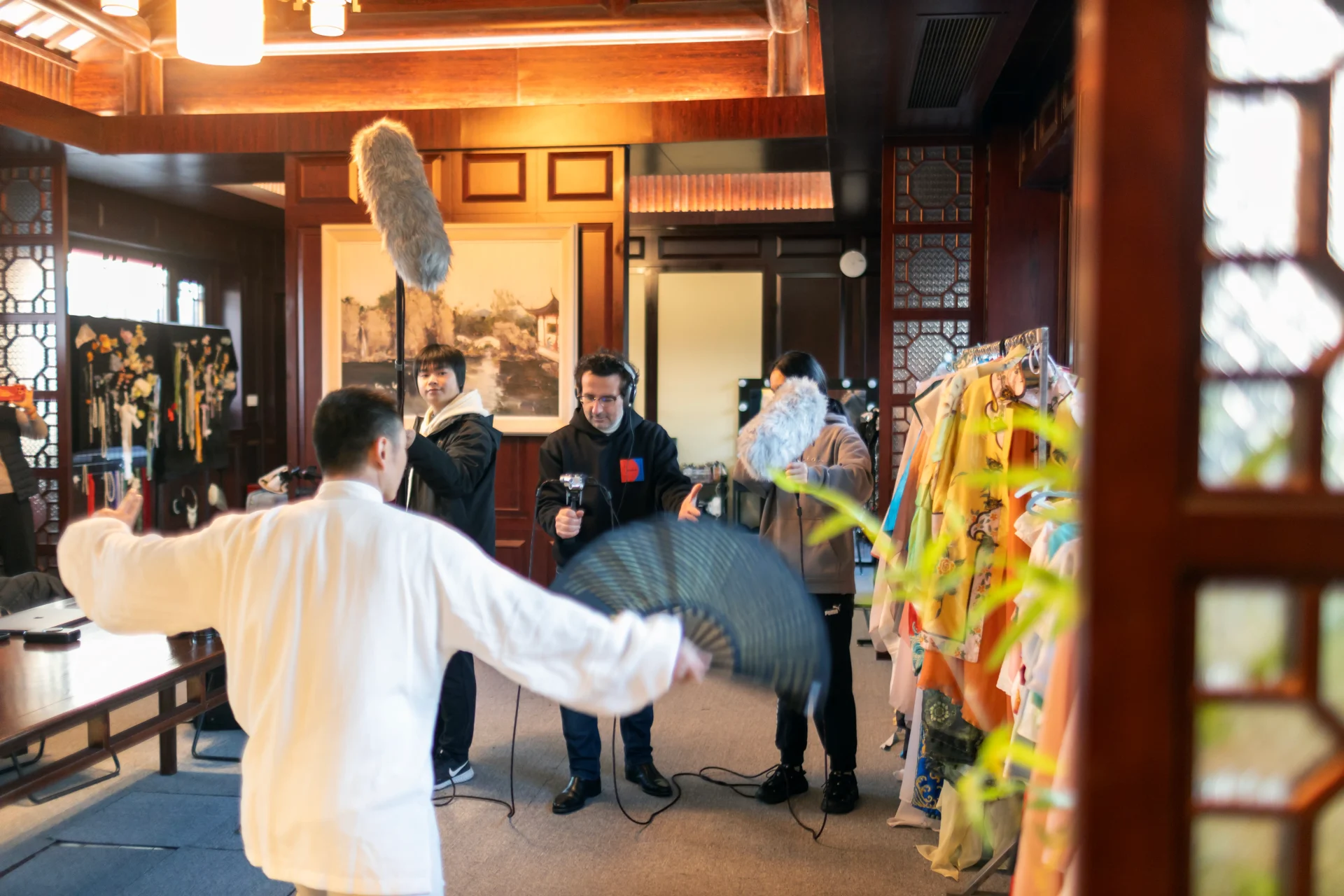
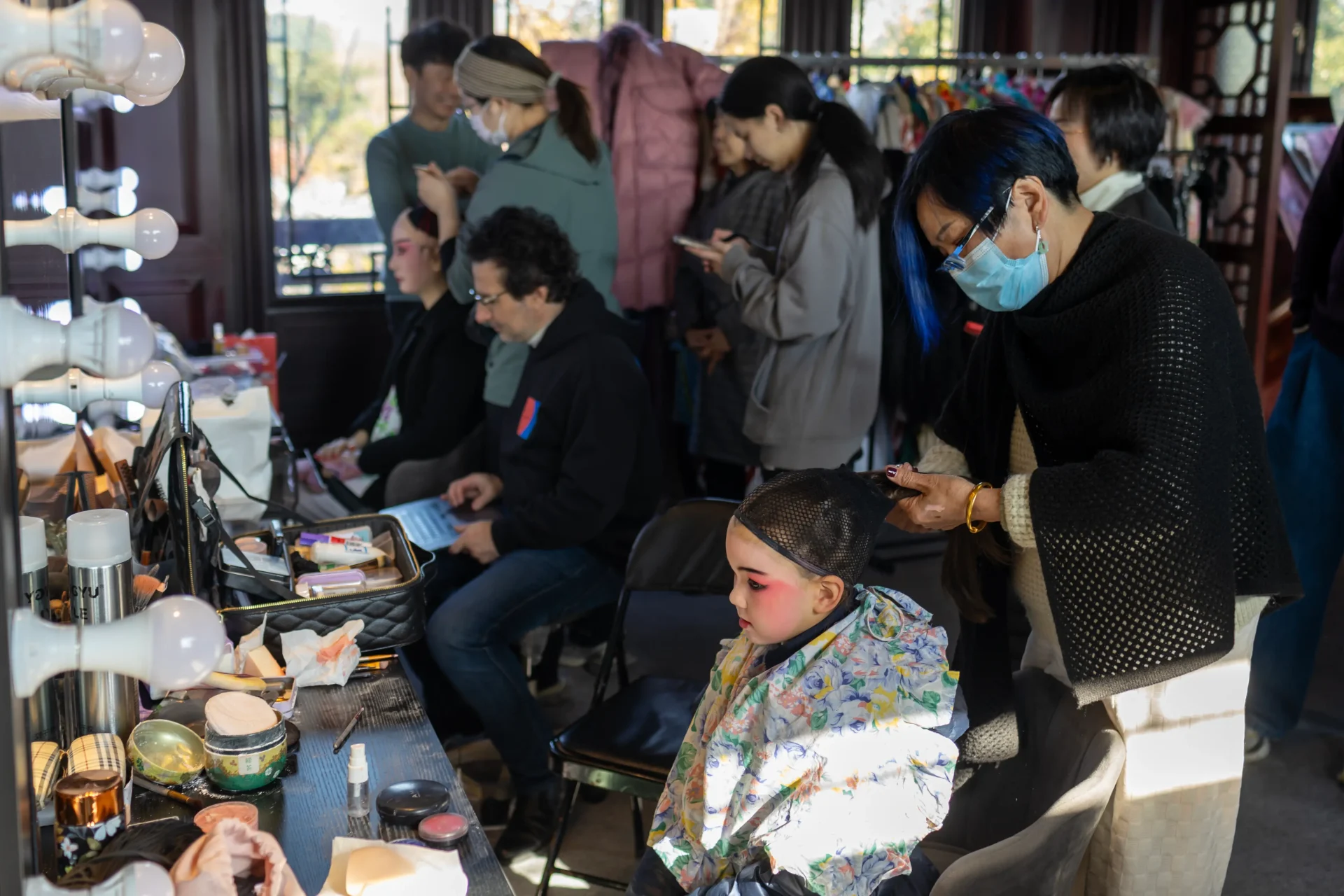
Traditional elements such as Kunqu Opera, the Qipao, and Tai Chi find a new role within «Sound of Shanghai – Opera of a Cosmopolis», emerging through the processes of planning, preparation, performance, recording, and filming — where heritage is applied within a contemporary artistic framework.
Behind the Scenes
Contributors
Collaborating Organizations in Shanghai
Representing a wide spectrum of public, academic, and artistic institutions, these partners contributed to the realization of the project through their expertise, cultural engagement, and creative collaboration.
上海地区合作单位
这些来自政府、学术与艺术领域的合作伙伴,
通过其专业支持、文化参与与创意合作,
共同促成了本项目的实现。
上海音乐声学艺术重点实验室 –上海市松江区文化和旅游局 –上海市松江区人文松江活动中心
(松江区非物质文化遗产保护中心) –上海市松江区人民政府岳阳街道办事处 –上海世博文化公园 –上海市松江区泗泾镇人民政府 –上海市松江区泗泾镇社区党群服务中心(文体) –上海泗泾商业旅游发展有限公司 –上海朱家角文化发展有限公司 –上海民族乐器一厂有限公司 –费迪曼逊四维音乐工程设计集团 –sE电声 –上海音乐学院音乐工程系
上海音乐声学艺术重点实验室 –上海序易影视文化传媒有限公司 –上海林肯爵士乐中心 –上海松江顾绣研究所 –上海梦乐昆曲澎派艺术研习中心 –上海海派旗袍文化促进会 –上海满庭芳海派旗袍艺术团 –MSSVOCAL全球声音教练联盟 –上海小蝌蚪音乐幼儿园 –新东苑·快乐家园 –上海莺悦舞蹈工作室 –意大利DeSisti灯光艺术公司 –荷兰Audinc音响工程公司