Marios Joannou Elia –
«The Magician of Sound».
Music as polymedia: from poly-aesthetic composition to cultural diplomacy bridging memory and society.
Awards
& Honors
Leadership &
Governance in Culture
Academic Activity,
Research & Publications
Education



Shaping contemporary music and culture.
Marios Joannou Elia (born 19 June 1978) is a composer, academic and artistic director of major cultural institutions, active at the intersection of music, politics and culture. Internationally recognised for his innovative large-scale works, he has been portrayed by musicologists, critics and the media as «musical phenomenon»1, «the man of the monumental»2, 3, «a pioneer among the composers of his generation»4, «a musical innovator»5, «the magician of sound»6, and «the child prodigy of contemporary music»7, 8, 9, 10, 11, 12, 13, 14, 15.
Artistic
Oeuvre.
to orchestras of cars
and city symphonies.
Elia is the creator of works with global scope and resonance.16 Symphonies, oratorios, operas, rhapsodies, choral works, festive compositions, among others, are distinguished for their originality, inventiveness, uniqueness, and the fusion of heterogeneous musical genres.17 His compositional output comprises around 100 works.18, 19, 20, 21, 22, 23, 24, 25, 26
The compositional trajectory to date is divided into two creative periods, reflecting the development of his artistic identity. The first period is characterized by experimentation and the exploration of new forms of expression, while the second is defined by large-scale, polymedial works with a ritual dimension and significant social impact.
First Creative Phase
During his first creative period, up to 2010, Elia was particularly devoted to an experimental artistic approach, concentrating on the exploration of contemporary compositional techniques and extended forms of expression. In this phase, he also developed a personal style of handwritten notation, which came to distinguish the scores of his works. Each page was conceived as a visual-compositional whole — an autonomous notational space with its own structural coherence, internal logic, and temporal dynamics.27

A landmark work of this period is «Strophes» (Strophes) for eleven voices (choir), instrumental ensemble, loudspeaker system, and electronics — a polymedial creation conceived for Volkswagen’s Transparent Factory (Gläserne Manufaktur) in Dresden (2003/04).28 The structural and acoustic features of the building were organically incorporated into both the musical design and the choreographic dimension of the work, transforming the architectural environment into an active compositional element. In this composition, Elia integrates the automobile for the first time and, beyond its sonic role, employs it as a tool of synchronisation: the score envisages an assistant conductor, who coordinates performers by means of the car. The conception of the work provided the basis for his notion of Polymediality — the fundamental aesthetic principle that characterises his creative trajectory.29 For «Strophes», he received the BMW Prize of the Musica viva contemporary music series of Bavarian Radio in Munich (2005).
Within the same aesthetic trajectory lies «Staubzucker» (Powdered Sugar), for guitar quartet, in which the guitar is used in a thoroughly unorthodox, percussive manner (2007).30, 31 The work has been performed over one hundred times across Europe, South America, and the United States, including appearances at the Boston GuitarFest and the Wrocław Guitar Festival. Classical Guitar Magazine described it as «a performance which one is not likely to forget».32, 33
The album «Staubzucker» (2016),34, 35, 36, 37 which includes nine works for guitar (1999–2008), received three Gold Medals at the Global Music Awards in California (2016), in the categories Contemporary Classical Music, Album, and Creativity & Originality.38 According to Canadian critic Bradford Werner:
«the album explores the sounds and inexhaustible possibilities of the guitar within chamber music, constituting a particularly significant contribution to the guitar repertoire».39

In 2002, Elia was invited by the Cambridge University New Music Society for the premiere of his work «With a Pair of Scissors and a Thousand Threads», in which a guitarist performs simultaneously on two guitars with different tunings.40 At the same time, he activates percussion instruments placed around him. The work belongs to an extended performance approach, whereby the performer functions as a multi-instrumentalist, adopting a refined, functional, and virtuosic form of multi-performance.
During the 2004/05 season, staged concerts of his works were presented in three different cultural venues in Salzburg: at the Mozarteum Foundation (Wiener Saal),41 at the experimental Toihaus Theatre,42 and in the Central-Kino Hall of the State Theatre.43

Manuscript (lower page) of «Ontologie Kubik» (2001) – Guitar duet based on a cubic notation system combining controlled chance with structural precision, documented in an 18-page performance catalogue.
Archetypal Patterns, Poetic Memory
and Music-Theatrical Inventiveness
The work «Antidoron» (Holy Bread), for amplified string quartet, in which the violin functions as the solo instrument against three strings, constitutes a tribute to the poet Kostas Montis and was completed immediately after his death in 2004.44 In the same year, the work received the First Prize at the prestigious International Witold Lutosławski Composition Competition in Warsaw, out of 169 participants, and premiered at the Warsaw Philharmonic (Philharmonia Narodowa).45, 46
«Blackwhite», for baritone and instrumental ensemble, is based on Montis’s poem Turkish Invasion (2005),47 while «Erdbeeren und Trauben» (Strawberries and Grapes, 2004), Elia’s String Trio No. 2, culminates with the poet’s characteristic phrase: «Tell me honestly, am I smiling?», capturing a moment of existential introspection and subtle irony.48
The music-theatrical work «Aquanauten», first staged in 2007 in the gardens of the Mirabell Palace in Salzburg, is distinguished by its humorous character. Drawing thematically on the Odyssey, with references to episodes such as Scylla and Charybdis, it reinterprets them with playful inventiveness and distanced theatricality. The five protagonists perform in front of a bathtub filled with water, which they employ simultaneously as a sonic medium, integrating the liquid element as a fundamental expressive device.49
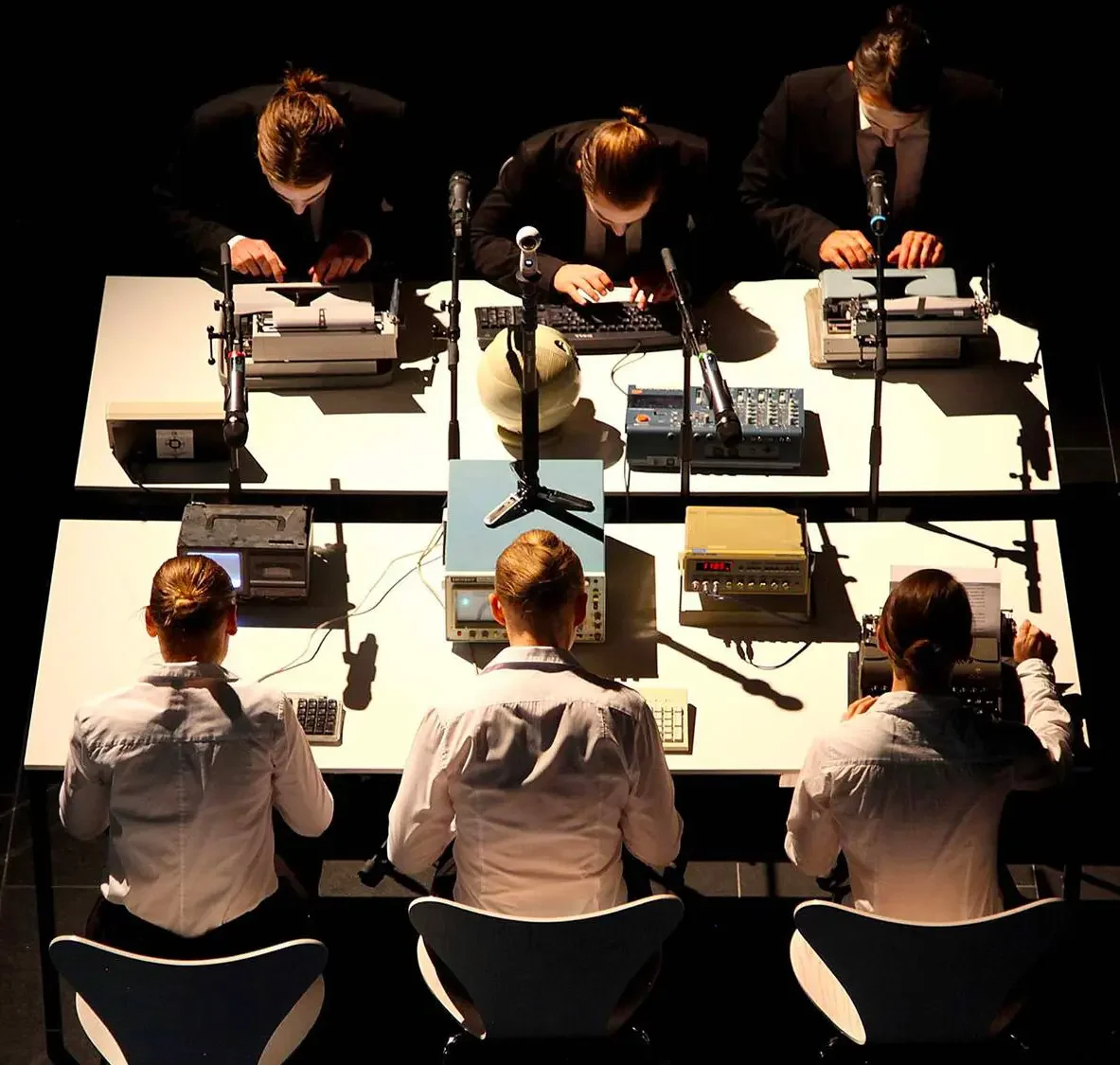
Shifting the focus to the digital world, «Telenauten» — presented, among other venues, in 2017 inside a cabin of the Vienna Giant Ferris Wheel in the Prater50 — engages with contemporary technology and the notion of communication, incorporating technological devices (hardware), and keyboards into its performative language. The work also integrates an excerpt from a philosophical text by Wolfgang Welsch.51, 52
In these creations, Elia shapes a personal imaginative language oriented towards his sonic expression. The performances are grounded in a hybridisation of singers and actors, moving between the musical and theatrical field, thereby transcending the boundaries between the two arts. A similar technique is employed in the opera «Die Jagd», where the protagonists are represented in dual form — by both singers and actors — with the identity of each role explicitly marked in the score, thus reflecting the dramaturgical and sonic stratification of the composition. This aspect points to his profound interest in ancient Greek drama, including tragedy, comedy, and satyr play, in which rhythmic and melodic speech, choral function, and multi-layered performance presence coexist.53
During his first creative phase, Elia cultivated a multifaceted literary output, writing poems and short theatrical texts in Greek, English, and German, which remain unpublished. Some of these writings were adapted into his musical works, while others evolved into music-theatrical compositions. One such example is «My Eyes, Only You» (2002), premiered at the Wiener Saal of the Mozarteum, a surreal nocturnal duet between two glowing eyes beneath a table draped in darkness, where the actors’ torches shimmered through the cloth like a shadow play — the eyes yearning to unite yet divided by a nose between them. The piece is based on non-semantic vocal material, using only phonetic and expressive utterances instead of linguistic text.
He further composed staged and scenographically conceived works, combining original texts, movement, and graphic notation, such as «eMotion Study» (2003) for actor (with any number of Orff or percussion instruments, musical toys, or self-made objects). Other works from this period include:
- «Vanished Statues» for three actors (2003).
- «Die Vitrine» for three actors and 4-/6-track tape (2003).
- «running through my veins» for two or three simultaneous projectors and live speech-play for three actors (2003–04; also realized as a multimedia version for two-track tape and projected film).
- «Just … Maybe…» for fisherman and four cyclists (2004).


The Vehicle Cycle
The «Vehicle Cycle» is a thematic series of works by Marios Joannou Elia, in which motor vehicles – or their components – are employed as sonic and scenic agents, actively contributing to the musical structure and dramaturgical narrative.54 Within this framework, vehicles are not merely treated as objects but function as «performers» with an operative role in the sonic-theatrical field of the composition.55
The opera «Die Jagd» (The Hunt, 2008),56, 57, 58 commissioned by the Stuttgart State Opera in co-production with Theater Rampe Stuttgart, is scored for six cars integrated as audio-visual presences – including an Aston Martin DB9 Volante and a Ford Shelby Mustang. The opera, in sixteen scenes, explores the duality of real and imaginary worlds, alluding to Shakespeare’s A Midsummer Night’s Dream. It combines four singers, three actors, children’s ensemble, two speaking choruses, twenty pre-recorded voices, instrumental ensembles, automobiles, and electronic sounds.59 Its six sold-out performances were covered by the main news broadcast of ARD.60
In «En Plo» (At Sea, 2007), for double bass, contrabass clarinet, electronic sounds, and loudspeaker orchestra, the focus is on two historical maritime events: the sinking of the ancient ship of Kyrenia, and the destruction of the Greek cruiser Elli at Tinos. The work integrates scenic and sonic objects such as parts of a sailing ship, fans, and chairs, which are mobilized during the performance to create a multi-sensory experience. Additionally, five types of electro-acoustic transducers disperse sound across space, projecting a spectral blend.61
The polymedia opera «Die Reise des G. Mastorna» (The Journey of G. Mastorna, 2006), based on Federico Fellini’s texts, was staged at Salzburg Airport (Terminal Amadeus) during the Year of Mozart. Its aviation-inspired aesthetic incorporated audience arrangement resembling an aircraft cabin, and juxtaposed artistic events with real-time flight operations, producing a hybrid experience where stage art and lived reality coexisted without merging.62
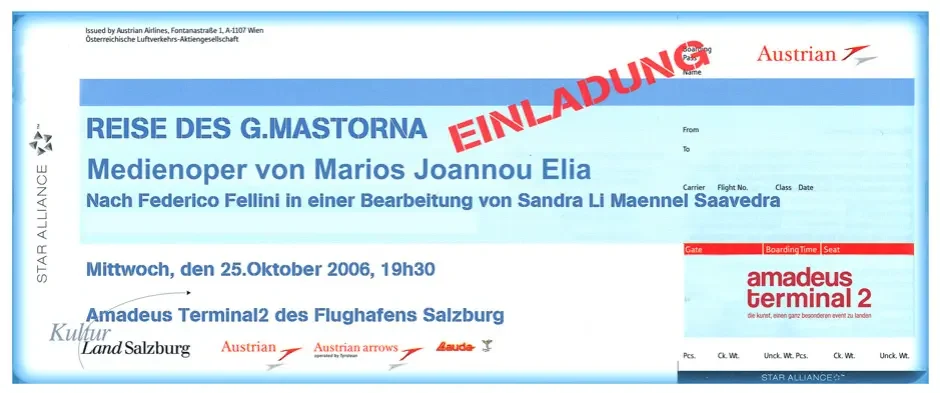
Invitation ticket for the premiere of «Die Reise des G. Mastorna» at Salzburg Airport in 2006 — designed as an authentic airline boarding pass, symbolically merging art and flight into a single journey.
«Tempus tantum nostrum est» (Only Time Belongs to Us, 2005), inspired by the motorcyclists’ demonstration at Deryneia in 1996, is written for four voices (or mixed choir) and two Harley-Davidson motorcycles.63 Its text derives from Seneca’s Epistulae morales ad Lucilium I.
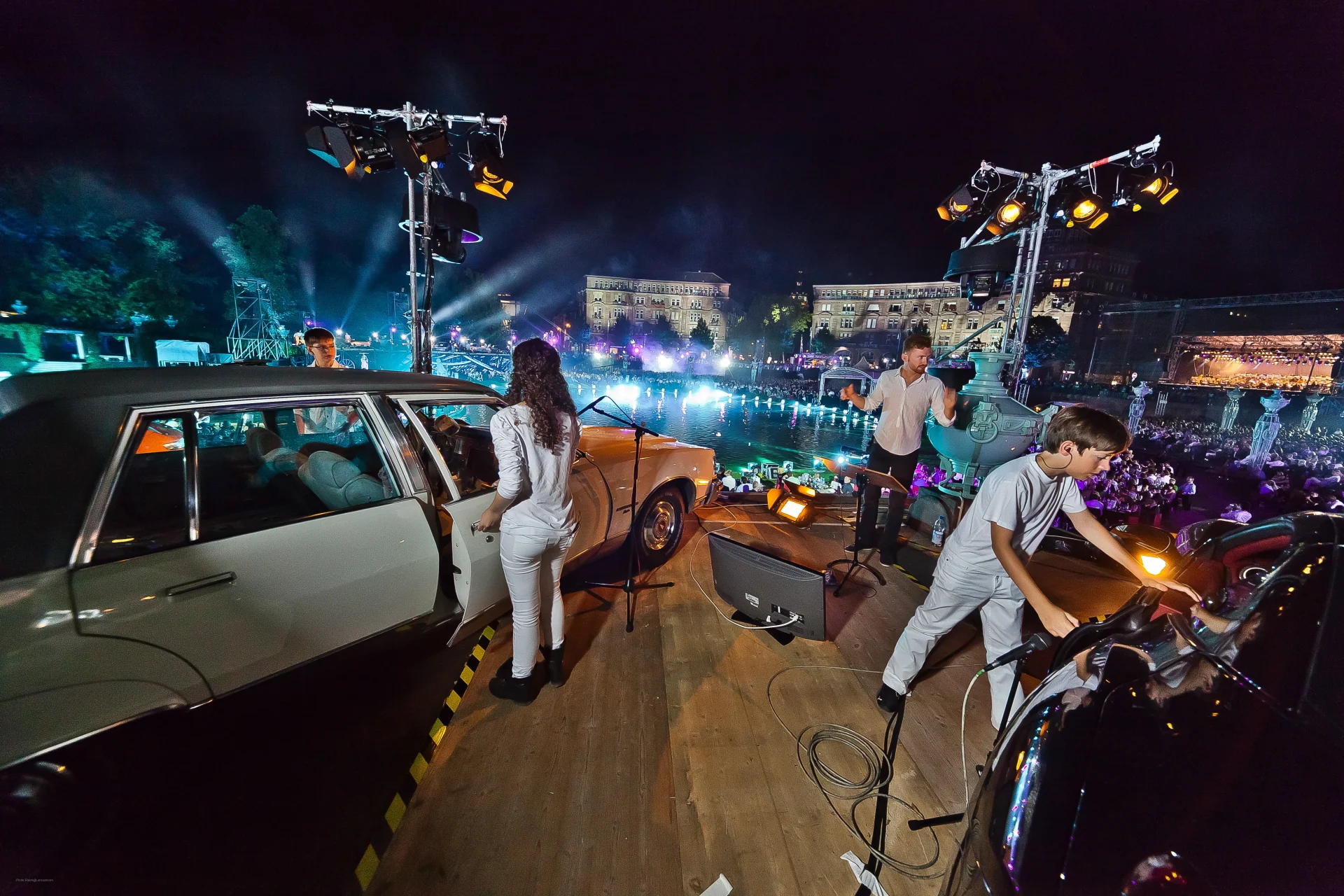
Other works of the cycle include «Der Wegweiser» (The Signpost, 2005) for sinfonietta, a bicycle-based composition premiered at the Berlin Philharmonie,64 as well as «Strophes», «Autosymphonic», and «Autotrio» – for three cars, fourteen percussionists, and electronics.65, 66, 67 This piece incorporated three iconic vehicles: the Mercedes-Benz SLS AMG (2010), the retro Aero 6218R (1934), and a replica of Karl Benz’s 1886 patented tricycle, the world’s first car. Its premiere in 2011 was held at the Mozart Hall, Rosengarten Congress Centre, Mannheim, during the official New Year’s reception of the City of Mannheim.
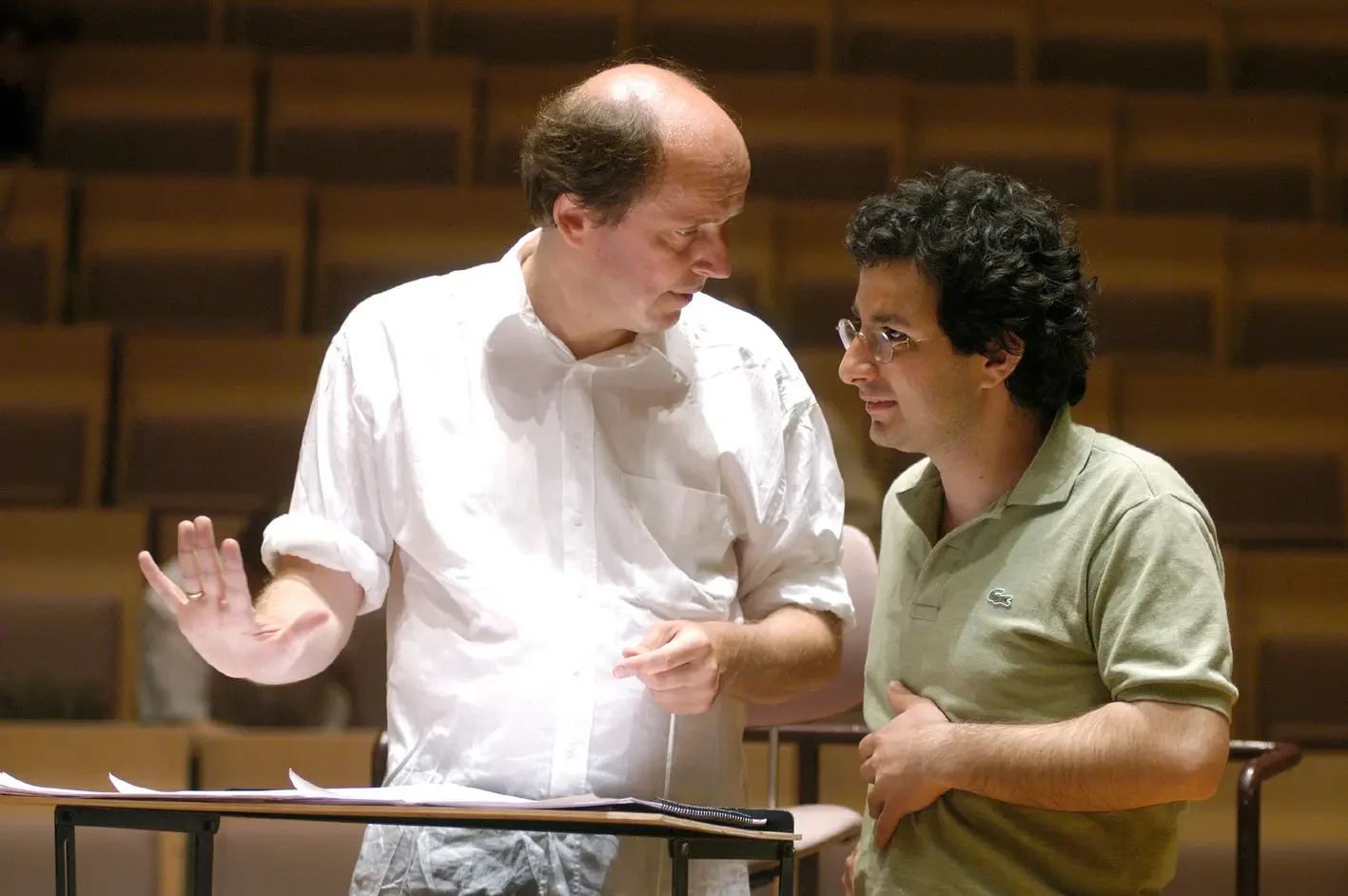
During his first creative period, Elia’s work received support from major European cultural institutions, including the Austrian Federal Ministry of Art, Culture, Public Service, and Sport, the Municipality and State of Salzburg, the Berlin Academy of Arts (Junge Akademie der Künste),68 Hellerau – European Centre for the Arts (Dresden), the Allianz Cultural Foundation (Munich), the Akademie Schloss Solitude (Stuttgart), the Baden-Württemberg Art Foundation,69 the Hanne Darboven Foundation (Hamburg), the German Harmonica Association (Trossingen), the Stiftung Kulturfonds Berlin, and the Hinrichsen Foundation (London).70


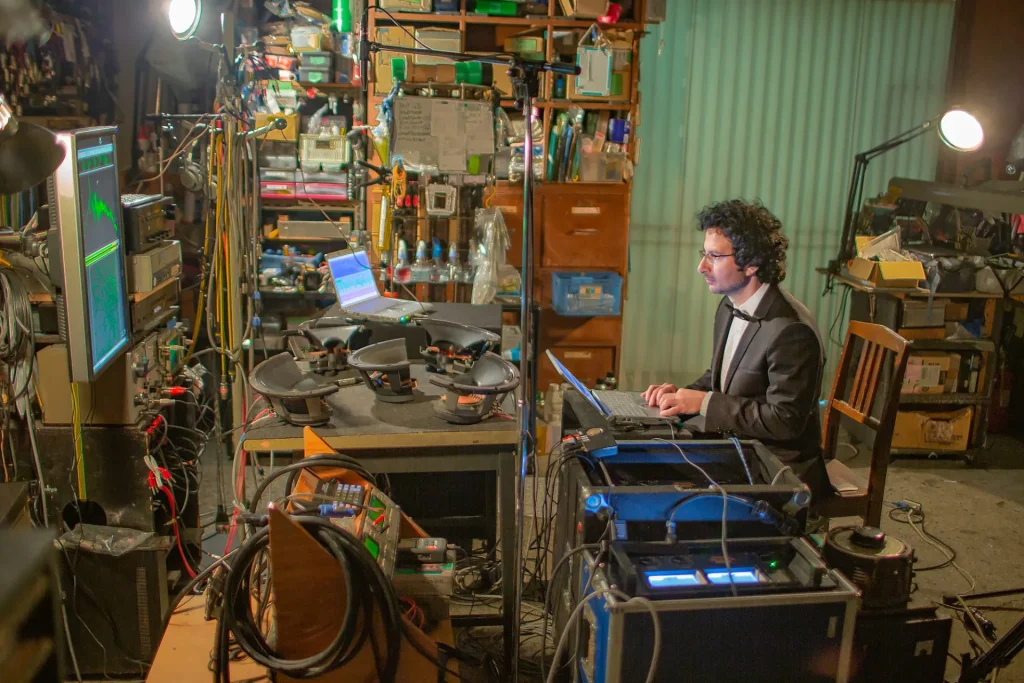
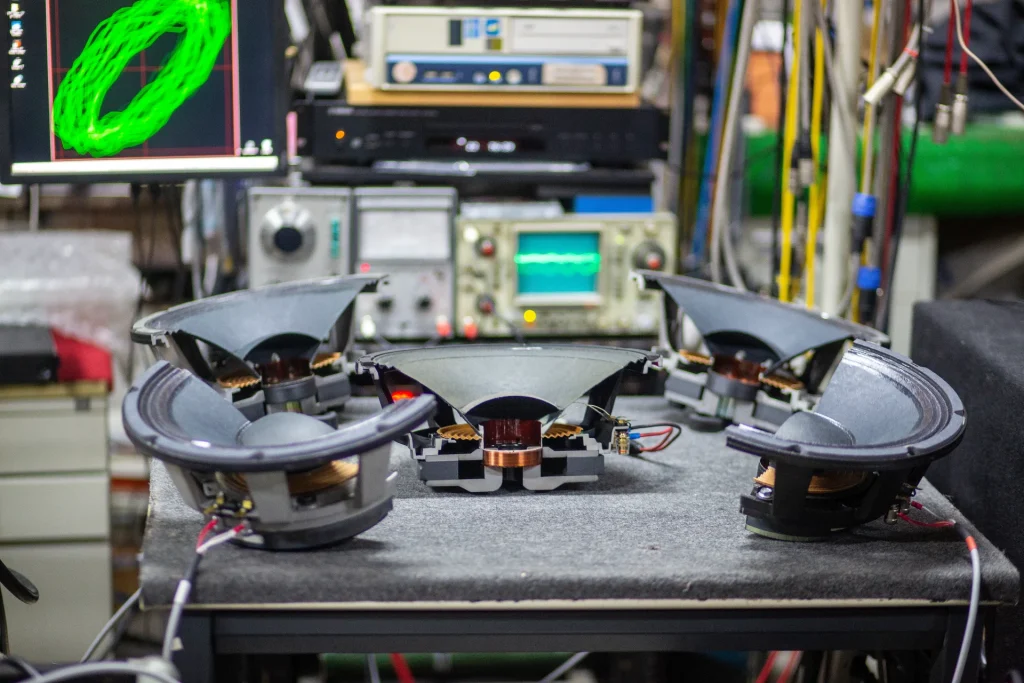



working with the Ibuki humanoid at the Intelligent Robotics Laboratory, Osaka University (Osaka, 2019).
Second Creative Phase
From 2011 onwards, with the premiere of «Autosymphonic» in Mannheim as its point of departure,71 Elia inaugurated his second creative phase. This period encompasses large-scale works, often of commemorative character, which combine high artistic standards with broad social impact and public visibility.
«Autosymphonic» - «The Work of the Century»
In a review published immediately after the premiere of the opera «Die Jagd»72 on December 28, 2008, in Welt am Sonntag, Elia expressed his personal vision:73
«My dream is a whole symphony orchestra made of cars.»
Mein Traum ist ein ganzes Sinfonieorchester aus Autos.
The critic’s comment followed:
«The composer Marios Joannou Elia has established himself thanks to his idiosyncratic sound worlds.»
Der Komponist Marios Joannou Elia hat sich mit eigenwilligen Klangwelten einen Namen gemacht.
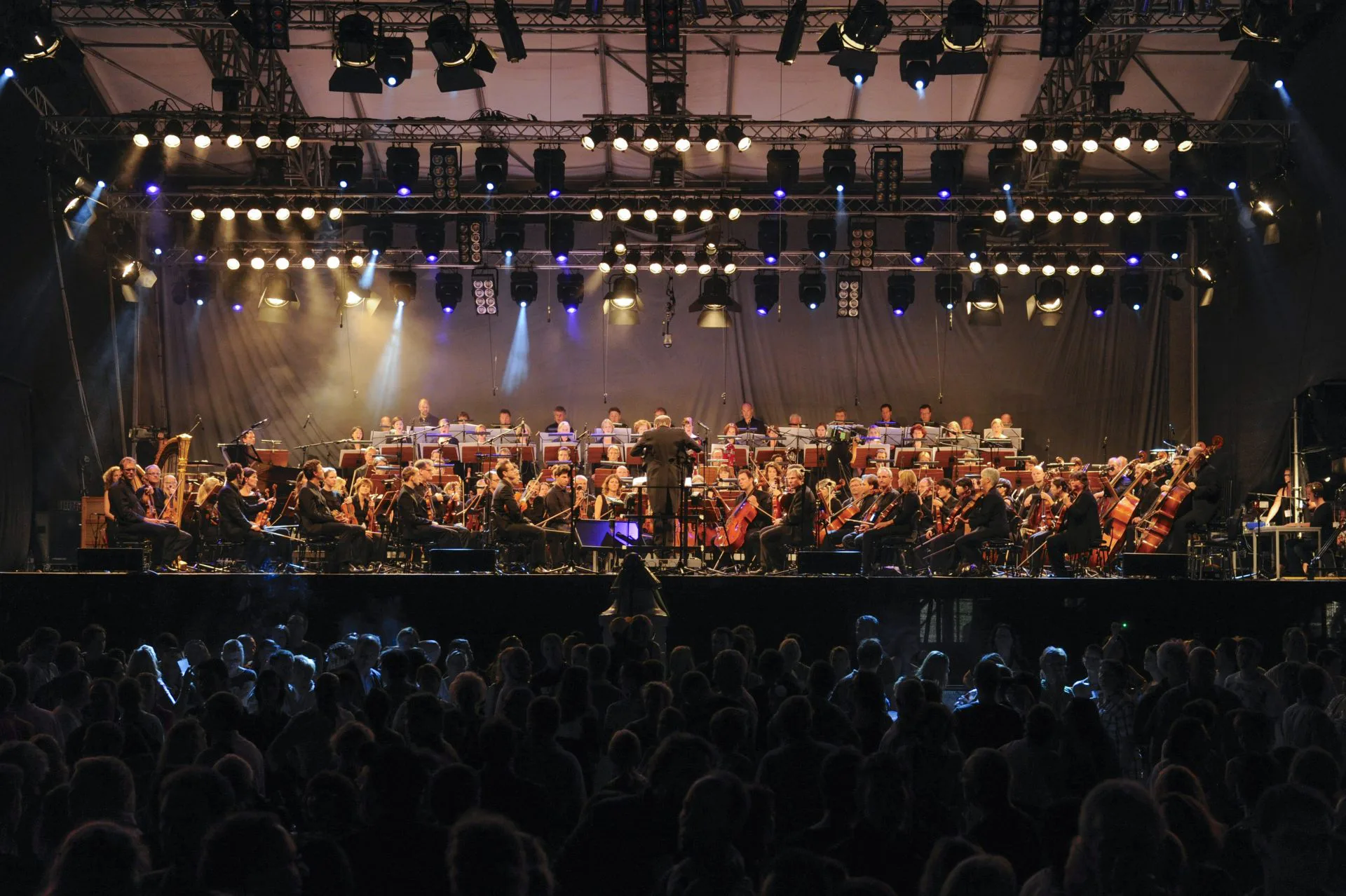
The multimedia «Autosymphonic» (2011)74 was created for the festive finale marking the 125th anniversary of the invention of the automobile and cost €2.7 million. It was commissioned by the City of Mannheim and the federal state of Baden-Württemberg in Germany. The premiere took place in the city’s central Friedrichsplatz square, across an area of 65,000 square meters, with the participation of 300 musicians — including a symphony orchestra, 120 percussionists75, 76, choir, children’s choir, pop band, percussion octet, electronic sounds, and a 360-degree sound system with 296 loudspeakers — as well as 500 technicians.77 For the execution of the music, a total of seventeen conductors were required: one central, two principal, and fourteen assistants.78, 79, 80
Particular sensation was caused by the inclusion of a unique «orchestra of 81 cars»81, among them Rolls-Royce, Ferrari, Porsche, and Mercedes-Benz, producing approximately 800 sounds.82 As the Salzburger Nachrichten headlined in an interview with the composer: «Ferrari as violin, tractor as tuba» (Ferrari als Geige, Traktor als Tuba),83 the title of his radio interview on Deutschlandfunk was equally telling: «Engines as melodies, horns as trumpets» (Motoren als Melodien, Hupen als Trompeten).84 In this way, Elia created the world’s first car orchestra, following a ten-month selection process in 2010.85, 86
The premiere was attended by 20,000 spectators at the event site, while the television broadcast reached an audience of 55 million. According to the German media, the work was described as «the work of the century»87, 88 and as the «Symphony of Superlatives» (Sinfonie der Superlative),89 due to its scale, complexity, and impressive conception. A study conducted by a local university in Baden-Württemberg estimated that the work’s publicity in the international media reached approximately two billion total impressions.90, 91

«Ulmer Oratorium» – Anniversary Work
for the World’s Highest Church Tower
The «Ulmer Oratorium»92, 93 is a commemorative composition by Marios Joannou Elia,94 commissioned by the City of Ulm to celebrate the 125th anniversary of the completion of the world’s tallest church spire, the Ulm Minster.95 Composed between 2013 and 2014, it was written for 400 performers, including ten soloists, seven choirs, two orchestras, and three main stages.96
The orchestration included coloratura soprano, lyric soprano, mezzo-soprano, tenor, bass, pop/jazz voice, violin, church organ, trumpet (with rhythmic recitation), electric bass, symphony orchestra, wind band, adult choir, children’s choir, bell orchestra, ensemble of Münsterbauhütte tools, percussion ensembles, and electronic media.97
The sound palette was expanded by tools from the cathedral’s restoration workshop (Münsterbauhütte), which — although not conventional instruments — were employed as sound-producing devices. In total, 46 objects such as hammers, grinders, and construction tools were used.98 In addition, a bell orchestra was conceived, incorporating both the Minster’s bells and other bell-like sound sources from the surrounding Münsterplatz.99
Elia approached the sacred space of the oratorio from a transcendent and cosmological perspective, embedding a symbolic reference to Mendelssohn’s oratorio «Elijah», which had been performed at the celebration of the tower’s completion 125 years earlier.100
The premiere, with a budget of €500,000, was scheduled for 29–30 May 2015 as an open-air event at Münsterplatz, before an audience of 4,500 spectators each evening. However, it did not take place. As revealed by Ulm’s mayor in his final council meeting, the project could not be realized because certain participants were unable to meet its artistic and technical challenges.101
This was not the first time that Elia’s works had faced non-realization due to their ambitious and innovative character. Already in his first creative phase (2006), two lyrical projects had not advanced to production: one for the Margravial Opera House in Bayreuth («Der Flötenzauberflöte», libretto by Goethe/Elia), and another at the Mozarteum’s renovated main stage in Salzburg («Oromumpaq», libretto by Simon Werle). In both cases, the pioneering and demanding nature of Elia’s vision was the decisive factor.
Nevertheless, his innovative stance received international recognition the same year. The German composer, musicologist, opera director, and conductor Udo Zimmermann, in a public tribute at Munich’s Herkulessaal to Elia’s work «Strophes», emphasized:
«It requires not only exceptional orchestration, but also a highly imaginative and unusual scenic environment. The composition demands the courage to use such means.»
During the same period, Elia’s music also reached a global audience: at the International Festival of Contemporary Music of the Korean Society of 21st Century Music in Seoul, he was awarded the Audience Prize for his work «Versteckspiel» (Hide and Seek).


The «Sound of» Series – Musicalisation of Cities
The «Sound of» series is a multi-site composition that merges musical creation, in-situ field recordings, cinema, and cultural narration. Each project seeks to musicalise a city, creating an audiovisual portrait that captures its identity through sound and image — weaving together traditions, people, architecture, and contemporary rhythms into a unified form of orchestral, vocal, electronic, and multimedia expression.103, 104
As the academic Elena Mouzala notes:
«Elia’s entire undertaking is the musicalisation of the earth through emblematic geographic locations.»105
- «Sound of Vladivostok» (2017),106 107 108 realized on the initiative of the ZARYA Center for Contemporary Art and the ZARYA Foundation, with support from Beluga Group, the Municipality of Vladivostok, and the Government of Primorsky Krai.109 More than 20 institutions and 350 musicians participated in the production. Russian media described it as «the city’s new anthem».110 111 112
- «Sound of Kyoto» (2018–19), subtitled «City in a Symphony»,113 114 115 116 created on the initiative of the Agency for Cultural Affairs of the Government of Japan, with the support of the Kyoto Municipality, and the Kyoto Art Center. The production involved 43 cultural institutions, 18 ensembles, including two symphony orchestras, and a total of 560 musicians.117 118 According to Tokyo Weekender:
«Composer Marios Joannou Elia orchestrates a masterpiece of sound dedicated to Kyoto.»119
- «Sound of Shanghai» (2024–25), subtitled «Opera of a Cosmopolis»,120 realized with the support of the Swatch Group121 and 29 partner organizations, including the Municipal Administration of Culture and the Department of Intangible Cultural Heritage of the City of Shanghai. A total of 250 musicians participated. Of the five central parts, each is composed for a different ensemble: one for a large Chinese traditional orchestra; one for a guzheng orchestra with women’s choir, and sheng; one for a Kun-operatic soprano and a ruan ensemble; and one for a jazz trio.
Across these projects, Elia assumes overall artistic direction and visual–scenographic conception. Production has been supported by international companies including Mosfilm,122, 123 Sony,124 De Sisti Lighting,125 Dolby, and Roland Corporation.

at the Kyoto Concert Hall, 2018.
Light, Friendship and Earth:
Music as Global Consciousness
«Gaia – The Earth’s Song», a symphonic rhapsody with its thematic focus on the environment and climate change, was commissioned within the framework of the German National Garden Exhibition BUGA23 in Mannheim.126 It received its world premiere at the Schwetzingen Palace, and was subsequently performed at Mannheim’s Spinelli Park in 2023. The text of the rhapsody is derived from the Homeric Hymn «To Earth, Mother of All».
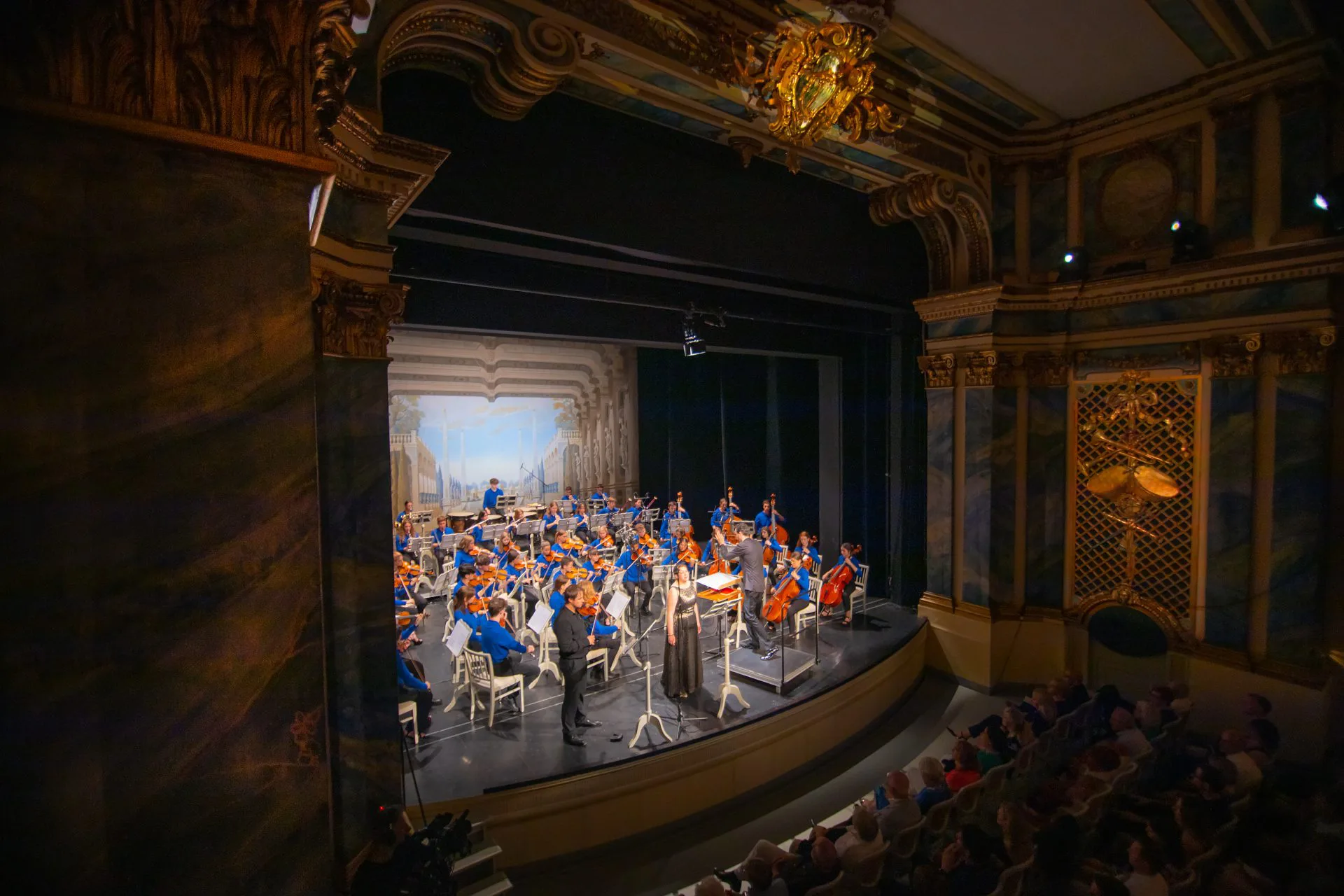
«Ode to Friendship», a concerto for soprano and large orchestra, was commissioned by the European Youth Orchestra Academy under the auspices of the European Parliament, on the occasion of the European elections, and the bicentenary of Beethoven’s Ninth Symphony in 2024.127 Its multilingual text reflects the vision of unity through linguistic diversity and intercultural dialogue.128
«Trumpet of God», a large-scale symphony composed between 2018 and 2023, and commissioned by the Pannonia Philharmonic in Pécs, Hungary, draws inspiration from the Book of Revelation of St. John (chapters 8–12), with particular emphasis on the section «The Seven Trumpets».129 The composition merges the genres of symphony, oratorio and trumpet concerto, creating a hybrid sound world imbued with eschatological intensity and prophetic drama.130
«Ode to Light» (Ode til Lyset) premiered in 2025 as the hymn of the Danish city of Næstved. It was commissioned by Næstved as European Capital of Culture 2032. It is a work for alto, mixed choir, and chamber ensemble, accompanied by a specifically designed lighting and visual installation integrated into the harbor landscape.131


followed by the performance under the illuminated canopy by the European Youth Orchestra Academy under Jan-Paul Reinke, 2023.
Music as Memory and Identity
in the Context of Greece and Cyprus
A segment of Elia’s oeuvre is dedicated to musical reflection on the historical trajectory, the trials, and the fundamental values of Hellenism, with a particular focus on Greece and Cyprus. In these compositions, music functions as an act of collective memory, cultural empathy, and existential reconstruction of national identity.132
In a recent speech titled «Memory as Creation – Universal Meanings from Displacement to Resurrection», Elia stated:
«My own history was not founded on roots, but on an uprooting.»133
«If memory is Crucifixion, creation is its Resurrection.»134
In this context, the ERT journalist Giorgos Dovolos described him as «ambassador of the musical culture of modern Hellenism».135
The commemorative symphonic work «Liberty» (Eleftheria),136 dedicated to the bicentenary of the Greek Revolution of 1821 and presented under the auspices of the President of the Hellenic Republic, was premiered at the Roman Agora in Athens, beneath the Acropolis, in 2021.137 138 Similarly, the oratorio «Weeping Madonnas»,139 140 conceived as a musical requiem for the mothers of the missing of 1974 and commissioned by the Presidency of the Republic of Cyprus, received its premiere at the Presidential Palace in Nicosia in 2022.
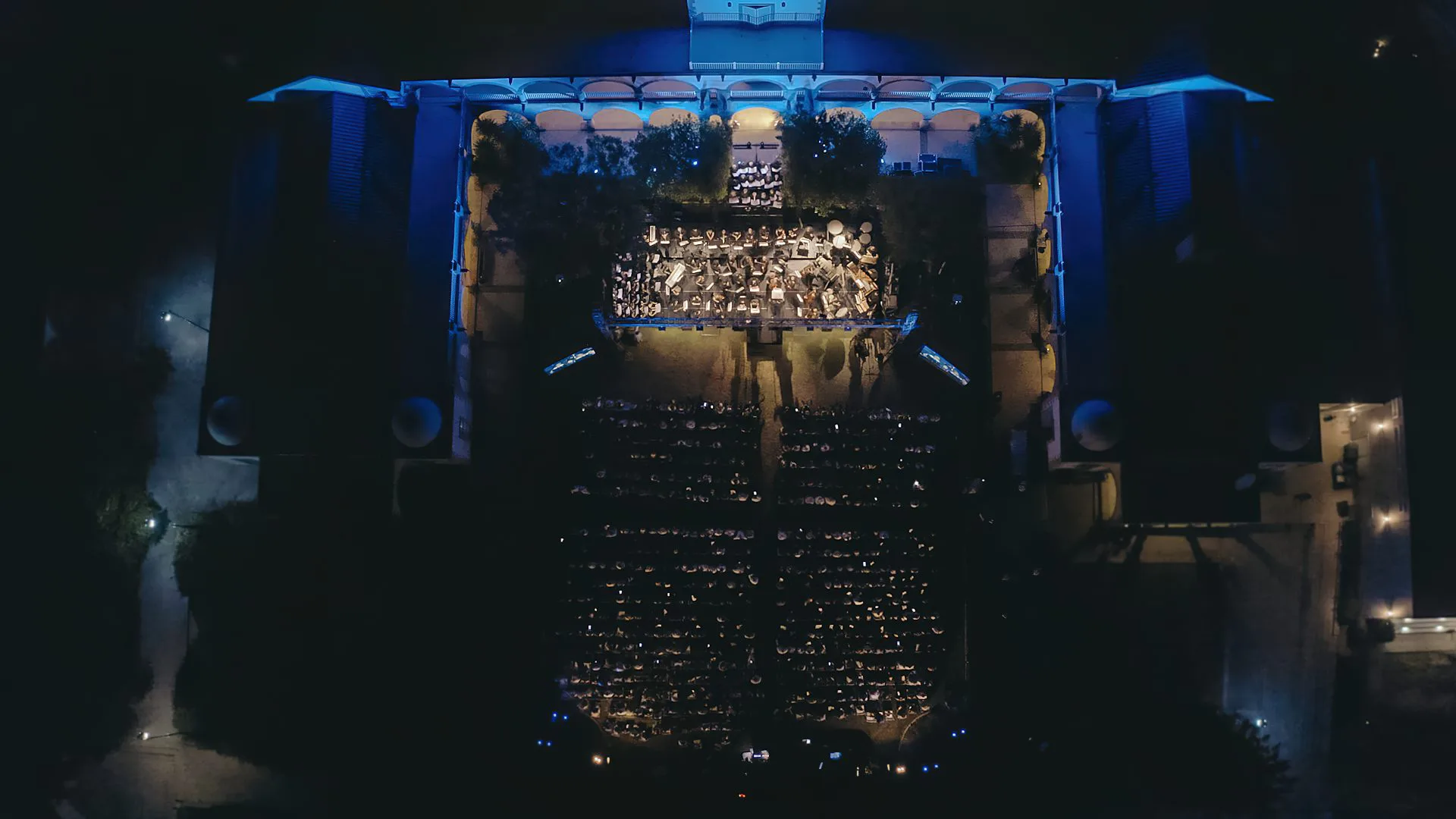
The oratorio «The Bells Will Ring Again»,141 commissioned by the Archbishop of Cyprus and the Holy Archdiocese of Cyprus, is an anniversary composition marking fifty years since the Coup d’État and Turkish Invasion of 1974. Structured in seven parts, it parallels the key events of Holy Week: Holy Wednesday and Thursday (Betrayal and Crucifixion), Good Friday (Burial and Lamentation), and Holy Saturday (Resurrection and Redemption). Conceived as an ode-testimony to Cyprus,142 it is imbued with lyricism and ritual intensity, conveying timeless messages of freedom, justice, and humanism. It was premiered at the Municipal Garden Theatre of Limassol143 and subsequently at the Herod Atticus Odeon in Athens in 2024.144 145 146 147
The symphonic composition «AIMA» (Blood), written for large orchestra, was performed by the Vienna Radio Symphony Orchestra (ORF) at the Golden Hall of the Musikverein during the Wien Modern Festival in 2024.148 It is structured around a distich from Vassilis Michaelides’ poem «The 9th of July 1821»: «The ploughshare while ploughing the earth …» (Το ’νιν αντάν να τρώ’ την γην…). Blood, as an archetypal symbol of human suffering, permeates the work as a cry of pain and resistance. The music acts as a voice of suffocation and redemption, weaving a universal sonic narrative of inner and historical catharsis.149
These works exemplify a creative trajectory firmly anchored in fundamental values such as democracy, freedom, ethics, human dignity, and universal human rights.150
In the oratorios «The Bells Will Ring Again» and «Weeping Madonnas», Elia adopts a hybrid musical idiom that intertwines Western European and Byzantine elements. This synthesis is articulated through the simultaneous use of a chanter and a lyric singer, a Byzantine and a mixed choir, as well as traditional and symphonic instruments. Moreover, performative elements with high symbolic resonance are interwoven, such as the firing of blank cartridges by a rifle platoon; in «Liberty», this extends to the participation of an Evzones Guard unit, with the distinctive sound of tsarouchia, and the use of cannons.151
Displacement as a Compositional Methodology
Marios Joannou Elia’s approach to composition and artistic thought is profoundly influenced by the Turkish invasion and occupation of Cyprus in 1974. Although he did not experience it personally, his parents originated from Kyrenia and were displaced, a fact that bequeathed to him an inner sensitivity toward loss, uprooting and memory.
These experiences are integrated into his art through structures that function as journeys – sonic odysseys seeking a homeland beyond geographical definition. This historical rupture reinforced his drive to create connections between cultures, eras, media of expression, people, and auditory worlds, combining tonal music with experimental techniques, natural and anthropogenic sounds, as well as electronic instruments and soundscapes.
In this framework, sound operates as a medium of return — not to a specific place, but to a metaphysical and spiritual homeland, where memory, identity, and culture are reactivated as living forces of continuity. From this perspective, his creative output transcends the individual and the national, inscribing itself within the universality of human experience.152 153 154 155 156
Illustrative Works
Elia’s compositional trajectory is characterized by polystylism, an expansion of expressive means and the exploration of heterogeneous stylistic domains. Works that reflect this artistic and technical multidimensionality include:157 158
- «Humanoid» (2019), for humanoid, semi-loudspeakers, electronic sounds and symphony orchestra, commissioned by the Symphony Orchestra of Osaka University, in collaboration with the Intelligent Robotics Laboratory and Professor Hiroshi Ishiguro.159
- «Abschied» (Farewell, 2016), for soprano, tenor, choir, two cellos, solo guitar and guitar orchestra, commissioned by the University Mozarteum Salzburg.160
- «Naval Symphony: Varyag» (2016–17), for soprano, tenor, symphony orchestra, choir and children’s choir, commissioned by the Primorsky Philharmonic for the Eastern Economic Forum.161 162 163 164
- The opera «Nichts. Als Wiederholung» (Nothing. But Repetition, 2008–09), in ten scenes, for seven soloists, choir, percussion quartet and ensemble (unpublished).165
- «Cursed» (2008), for classical and electric guitar (also in a solo guitar version), is a monophonic work of conceptual minimalism based exclusively on the note E, repeated across all possible fretboard positions. Despite the apparent simplicity of its material, the piece reveals considerable complexity and is characterized by high performance difficulty, demanding absolute precision, refined timbral control and sensitivity to micro-differences. Through its ascetic reduction of musical material, the work operates both as tonal deconstruction and a virtuosic study of monophony, variability, and the acoustic identity of a single sound within its seeming homogeneity.166 167
- «Thalatta, thalatta!» (2007), for mandolin and ensemble, commissioned by the Klangspuren Schwaz Festival in Tyrol.168
- «Spiegel:Eye» (2006), for ensemble, eleven loudspeakers and live electronics, titled with a wordplay combining German (Spiegel, «mirror») and English (Eye, «eye»), while phonetically evoking Spiegelei («fried egg»). Premiered at the Dresdner Tage der zeitgenössischen Musik, commissioned by the Europäisches Zentrum der Künste Hellerau.169
- «C Story» (2006), for mixed Western and non-Western ensemble, premiered at Muziekgebouw aan ’t IJ, as part of the Gaudeamus Festival in Amsterdam.170
- «Elpis», commissioned by the Deutscher Harmonika-Verband e.V. in Trossingen (2006/07), was originally written for accordion orchestra. A chamber version for accordion septet and percussion duet received its premiere at the Gaudeamus Festival at Muziekgebouw aan ’t IJ, Amsterdam, performed by the Nederlands Accordeon Ensemble (2008).
- «Drei Löffel Zucker im Meer» (Three Spoonfuls of Sugar in the Sea, 2005), for seven voices, premiered at the Toihaus Theater Salzburg, featuring actor Max Simonischek.171 172
- «As Time Goes By» (2005), a chamber opera for five singers and eleven instruments, commissioned by the State Opera of Hanover and Deutsche Bank, and premiered during Einstein Year 2005 at the eight-storey Ministry of Science and Culture of Lower Saxony .173 174
- «Tessera» (2004), for recorder duet and contrabass trio, premiered at the Darmstadt Ferienkurse (Orangerie).175 There is also a version of the piece for a recorder player, who, among other recorders, performs simultaneously on two piccolos and a sewing machine.
- «hydor ~ chronos» (2002/04), subtitled antique, for electroacoustic music and video, based on Elia’s text Chronogram. Commissioned by the Cultural Funds of Salzburg, premiered in 2004 at the Haus der Mozarteum Orchester, and later presented in spatial format at the Osterfestspiele Salzburg (2006).176
- «Matryoshka» (2019), for 289 matryomin players with piano; composed for the Guinness World Record attempt (largest matryomin ensemble) and commissioned with the Japanese and Russian Theremin Schools for the theremin centennial. Premiered on 14 September 2019 at the Design and Creative Center Kobe, centred around Ensemble «Mable and Da» under Masami Takeuchi, with the daughter, granddaughter, and great-grandson of Leon Theremin participating. The matryomin is a Japanese derivative of the theremin embedded in a matryoshka doll, performed without touch.187 188 189 190
- Hymn of The Cyprus Institute (2024), bearing the motto «Know the right moment and, knowing it, act» (καιρὸν γνῶθι και γνοὺς πρᾶττε), official institutional hymn with accompanying ceremonial procession music for the graduation ceremony of The Cyprus Institute.186
- «Victory and Triumph» (2020), for soprano, symphony orchestra, choir, and drums, composed on the occasion of Olympiacos FC winning the 45th Greek Superleague Championship. The work intertwines the symphonic music with athletic spirit and served as the basis for the light and pyrotechnic show (directed by Asteris Kutulas) during the trophy ceremony at the Karaiskakis Stadium in Piraeus.182 183

International Performances and Collaborations
Elia’s compositions have been performed internationally by distinguished orchestras, choirs and ensembles, including the Symphony Orchestra and Choir of the Southwest German Radio (SWR), the ORF Vienna Radio Symphony Orchestra, the Gewandhaus Orchestra Sinfonietta in Leipzig, the Stuttgart State Orchestra, the German Radio Philharmonic Saarbrücken–Kaiserslautern, and the Pacific Symphony Orchestra.177 In Asia, the National Chinese Orchestra, the Kyoto and Osaka Youth Symphony Orchestras and Choirs, as well as the Jinqi Ruan Ensemble and the Guzheng Orchestra of the Shanghai Conservatory of Music, are among the interpreters of his works. In Greece and Cyprus, contributions have come from the Symphony Orchestra and Choir of the Hellenic Broadcasting Corporation (ERT), the Choir of the Municipality of Athens, and the Cyprus Symphony Orchestra. Specialized ensembles have also taken part in his performances, such as the Children’s Choir of the Stuttgart State Opera, the Schleswig-Holstein State Youth Choir, the FEFU Academic Choir, the Accordion Orchestra of the Netherlands, the Mandolin Orchestra of Kyoto, and the Japanese matryomin ensemble «Mable and Da». A particular place is held by Byzantine choirs, including those of the Holy Archbishopric of Cyprus, the Holy Monastery of Kykkos, the «Maïstores of the Psaltic Art», the «Psaltai of Ilissia», and the chant ensemble «Enichima».
His operas have been staged by the State Operas of Stuttgart178 and Hanover. In other works, soloists from the Mariinsky Theatre, the Berlin Philharmonic and Bavarian Symphony Orchestra, the Warsaw National Philharmonic Orchestra, and the Hungarian State Opera in Budapest have participated. His performance repertoire also includes collaborations with the German soul and R&B singer Xavier Naidoo,179 the group Söhne Mannheims, as well as with ensembles specializing in contemporary music such as Ensemble Modern (Frankfurt), Ensemble Recherche (Freiburg), Ensemble Phoenix (Basel), Ensemble KNM Berlin, Ensemble SurPlus (Freiburg),180 Ensemble Ascolta and SWR Vokalensemble (Stuttgart),181 Austrian Ensemble for Contemporary Music (Salzburg), the Rubinstein Quartet (Łódź), the Doelen Kwartet (Rotterdam), the Danish Chamber Players (Ensemble Storstrøm), and the Moscow Contemporary Music Ensemble.
Elia’s works have been presented in some of the world’s most prestigious venues, including the Berlin Philharmonie and Warsaw Philharmonic, the Festspielhaus Hellerau in Dresden, Queen’s Hall in Edinburgh, Muziekgebouw aan ’t IJ in Amsterdam, Millenáris Theatrum in Budapest, Witold Lutosławski Concert Studio of Polish Radio in Warsaw, Ars Electronica and the State Theatre of Linz, the Gasteig in Munich, the main stage of the National Opera and Ballet of North Macedonia in Skopje, the Centro Nacional de la Música in Buenos Aires, the Palacio de Bellas Artes in Mexico City, and the Rotunda of Steinway Hall in New York. He has also composed works specifically for Salzburg Airport (Amadeus Terminal 2, «Mozart Year 2006»), the historic Mirabell Garden (Mirabell Palace), and the Georgios Karaiskakis Stadium in Piraeus.182 183
Elia has represented Cyprus in a series of international cultural events,184 including: the closing ceremony of the «Cultural Year of the Ten» in Berlin, marking the accession of ten new member states to the European Union (2005); the «Cultural Days» of the European Central Bank in Frankfurt (2008); the project «Art–Peace – Challenging Walls» in Berlin, with the participation of artists from cities divided by separation walls (2008); the 14th Biennale of Skopje (2009);185 and the events «Louise, Destination Europe» and the exhibition «Very European People» in Brussels, within the framework of the Belgian Presidency of the Council of the European Union (2012).
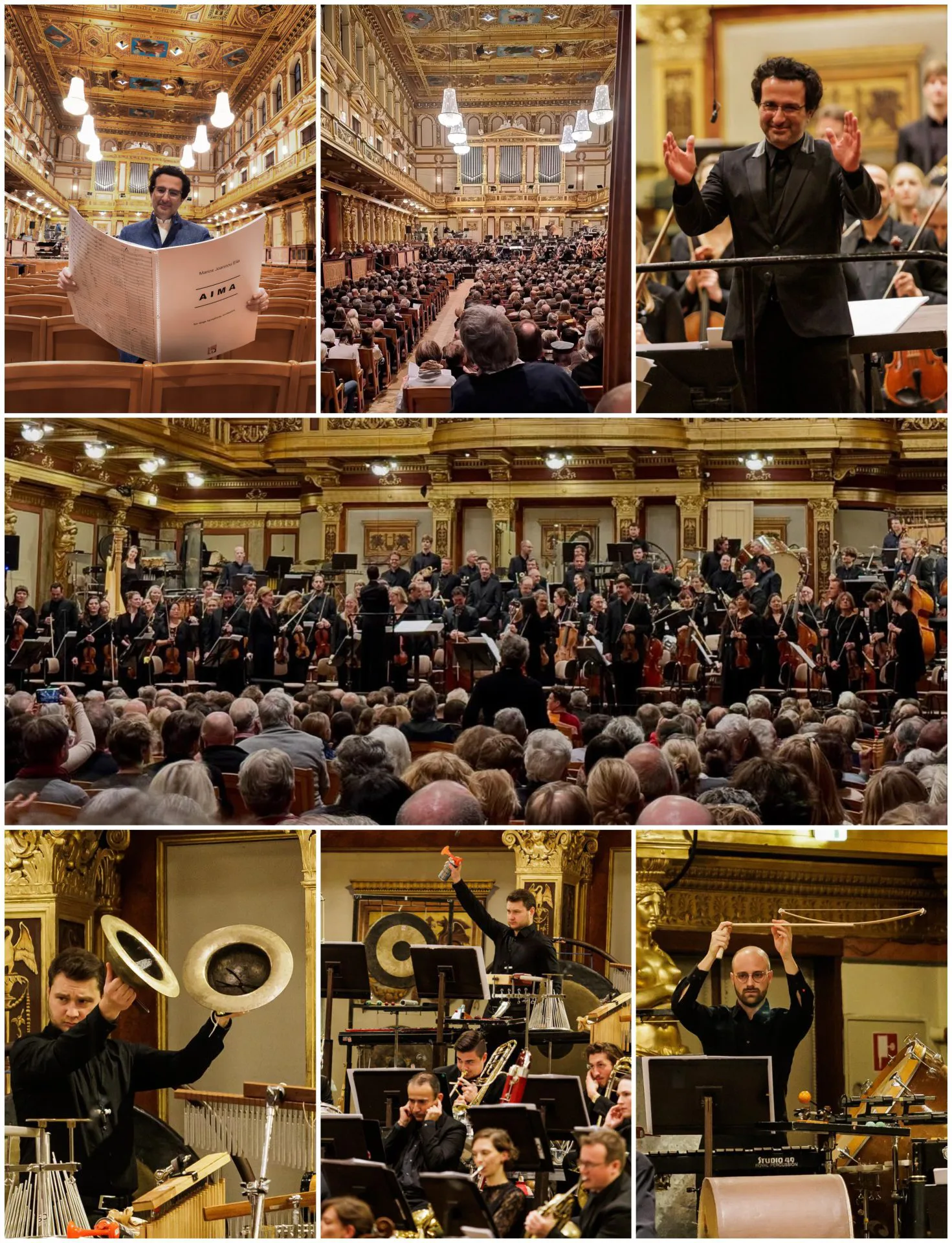
at the Musikverein (Golden Hall) during Wien Modern – Claudio Abbado Concert, 2024.
Architecture & acoustics in the score.
From iconic halls to repurposed industrial sites, established and unconventional urban venues,
Elia’s productions tune orchestration, spatial sound, and staging to each site’s architecture and native acoustics — so the space doesn’t just host the music; it becomes part of it.


Works by the numbers.
The numerical data presented here represent more than statistics; they function as indicators of scale, innovation, and artistic ambition within Elia’s oeuvre. Each figure encapsulates the structural and performative parameters of singular works — whether through the unprecedented deployment of performers, the integration of technological systems of exceptional magnitude, or the realization of record-setting events. Taken together, these quantitative markers illuminate the distinctive intersection of compositional vision, spatial design, and cultural context that defines his large-scale projects.
compositions
From solo pieces to large-scale works.
ensembles, orchestras and choirs
Commissions and collaborations with established institutions.
TV viewers
People who watched a single premiere broadcast («Autosymphonic»).
countries
Performances and broadcasts.
audience members
Concertgoers at a single premiere («Autosymphonic»).
media contacts
Publicity in international media for one project over two years («Autosymphonic»).
7 choirs + 2 large orchestras
Combined forces in a single composition («Ulmer Oratorium»).
Triple-stage layout
400 musicians, one performance — distributed forces with unified direction («Ulmer Oratorium»).
17 conductors
Central, principal, and assistant conductors aligned for a single performance («Autosymphonic»).
125 performers on 81 cars
Precision performance after a year of intensive training («Autosymphonic»).
33 consecutive plays
«Ode to Light», Næstved Harbour - 31.10-16.11.2025.
6 sold-out performances
«Die Jagd», Stuttgart (opera).
10 soloists
in a single oratorio — «Ulmer Oratorium».
9 performers on a single car
«Autotrio».
166,344 notes
within the symphony «Trumpet of God».
479 individual tracks
in the mixing of «Sound of Shanghai».
289 performers of the same instrument
«Matryomin» — Guinness World Record, Kobe 2019.
296 loudspeakers — 500,000 Watt, 25.4 tons
230 channels for live mixing («Autosymphonic»).
References.
Click to open.
- Evangelou, Marilena. «The musical phenomenon Marios Joannou Elia on the WebTV of Politis». Politis, 10 January 2018.
- Hub, Dagmar. «Ein Mann fürs Monumentale». Augsburger Allgemeine, 23 April 2014.
- Manhart, Thomas. «Ferrari als Geige, Traktor als Tuba. Salzburger Nachrichten – Der Komponist Marios Joannou Elia setzt Autos als Instrumente ein» (PDF, archived). Salzburger Nachrichten, 4 June 2011.
- Dovolos, Georgios. «Ο Διακεκριμένος Συνθέτης Μάριος Ιωάννου Ηλία στο Τρίτο Πρόγραμμα [2/2]». ERT Trito, 15 September 2024.
- Raab, Harald. «Sinfonie der Superlative zum Auto-Geburtstag» (archived). Mittelbayerische Zeitung, 11 September 2011.
- Giraudet, Jean-Paul. «Marios Joannou Elia» [‹der Klangzauberer›]. Musicalics, 20 April 2005.
- Pliakos, Kostas. «From Cyprus to Vladivostok, Two Notes Away». CNN.gr, 16 December 2017.
- Pliakos, Kostas. «A Cypriot Composer Writes the Musical Identity of Kyoto». CNN.gr, 2 January 2019.
- Reporter. «The Paphian who was described as ‹child prodigy of contemporary music› by CNN». 28 March 2019.
- Antoniou, Stavros. «The child prodigy of contemporary music named Marios J. Elia (photo+video)». OmegaLive, 20 December 2017.
- Savvinidis, Giorgos. «Marios Joannou Elia: The Notes of Life». Phileleftheros.
- Zanettos, Luka. «Zulucast Talk Podcast S1 E23 | Marios Joannou Elia: The ‹child prodigy› of contemporary music». Zulucast Talk, 30 December 2020.
- Mitropoulos, Giorgos. «‹The Sound of Kyoto›: Marios Joannou Elia composes the musical portrait of the city». Euronews, 1 June 2021.
- The Impossible Works Team. «Ibuki stars in the new work of Marios Joannou Elia». Avant-Garde.
- Savva, Phinio. «Marios Joannou Elia: The composer who made Cyprus’s name known worldwide». Reporter.
- «Marios Joannou Elia». ERT echo. 15 September 2024. Retrieved 1 July 2025.
- «Prize of the Republic of Cyprus to Marios Joannou Elia – Cyprus Academy of Sciences, Letters and Arts» (in English). Retrieved 1 July 2025.
- «Music Information Centre Austria». db.musicaustria.at. Retrieved 14 February 2023.
- Grund, Vera (2015). «Between Freedom and Determination: Marios Joannou Elia’s Music for Guitar». Perspectives of New Music 53 (2): 177–188. doi:10.1353/pnm.2015.0010. ISSN 2325-7180.
- Alogoskoufi, Cassandra (21 July 2017). «Vertumnus, the God of Transformations». Poiein. Retrieved 14 February 2023.
- Pampouhidou, Georgia (14 July 2022). «Cyprus: On 20/7 the premiere of the work ‹Weeping Madonnas› by M. I. Elia – Dedicated to the mothers of the missing persons». ERT News. Retrieved 14 February 2023.
- Savva, Phinio. «Marios Joannou Elia: The composer who made the name of Cyprus known worldwide». Reporter. Retrieved 14 February 2023.
- The Impossible Works Team. «Ibuki stars in the new work of Marios Joannou Elia». Avant-Garde. Retrieved 14 February 2023.
- «Ulmer Münster – Spectacular work by composer M. Elia for the celebrations of the tallest church in the world». Offsite.com.cy. Retrieved 14 February 2023.
- «The composer M. Elia at the tallest church in the world». Kathimerini.com.cy. Retrieved 14 February 2023.
- «New spectacular composition by Marios Joannou Elia». Politis. Archived from the original on 14 February 2023. Retrieved 14 February 2023.
- Elia, Marios Joannou. «The Concept of Polymediality». Mainz: Schott, Schott Campus, 2017. ISBN 978-3-95983-101-7. pp. 14, 27, 30, 38–39, 70–72, 76, 78–79, 82–84, 89.
- «Strophes – Multimedia-Komposition für 11 Stimmen, instrumentales Ensemble, Lautsprecher-Ensemble und Elektronik». Music Information Centre Austria. Retrieved 1 July 2025.
- Elia, Marios Joannou. «Music’s Incited ‹Augmented Reality› in Xenakis’s Polytopes, Scriabin’s Mysterium and Polymediality». Bulletin of the Transilvania University of Braşov. Series VIII: Performing Arts, 21 December 2022. ISSN 2344-200X, pp. 101–114. doi:10.31926/but.pa.2022.15.64.1.7.
- Rodrigo Villaseñor. «Staubzucker – Marios Joannou Elia // Guided reading with shapes and video». YouTube, 3 October 2017. Retrieved 8 July 2025.
- «Staubzucker». Music Information Centre Austria (search.moz.ac.at). Retrieved 9 July 2025.
- Werner, Bradford. «Staubzucker by Marios Joannou Elia». This is Classical Guitar, 20 January 2016. Retrieved 4 July 2025.
- Grund, Vera. «Between Freedom and Determination: Marios Joannou Elia’s Music for Guitar». Perspectives of New Music 53, no. 2 (2015): 177–188. ISSN 2325-7180.
- Werner, Bradford. «Staubzucker by Marios Joannou Elia». This is Classical Guitar, 20 January 2016. Retrieved 1 July 2025.
- Grund, Vera. «Between Freedom and Determination: Marios Joannou Elia’s Music for Guitar». Perspectives of New Music 53, no. 2 (2015): 177–188. doi:10.7757/persnewmusi.53.2.0177. ISSN 0031-6016.
- «Staubzucker». Spotify, 25 November 2015. Retrieved 14 July 2025.
- «Marios Joannou Elias neue CD Staubzucker: Ein bahnbrechendes Album der Gitarrenmusik». OpenPR, 2016. Retrieved 14 July 2025.
- «Marios Joannou Elia’s new CD Staubzucker: A Ground-breaking Album of Guitar Music». The Journal of Music – Music in Ireland, 14 July 2016. Retrieved 1 July 2025.
- Werner, Bradford. «Staubzucker by Marios Joannou Elia». This is Classical Guitar, 20 January 2016. Retrieved 4 July 2025.
- «Elia Marios Joannou». Music Information Centre Austria. Retrieved 8 July 2025.
- «Burning motions – Bühnenkonzert in 12 Szenen». Music Information Centre Austria. Retrieved 9 July 2025.
- «Das Geheimnis des Kleiderbügels». Music Information Centre Austria. Retrieved 9 July 2025.
- «Refurbished – Bühnenkonzert in 6 Szenen». Music Information Centre Austria. Retrieved 9 July 2025.
- «Antidoron (Holy Bread)». Music Information Centre Austria. Retrieved 1 July 2025.
- «February 2005 – Polish Music Center». polishmusic.usc.edu. Retrieved 9 July 2025.
- «Final report of the jury of the Lutoslawski Award 2004». Mundoclasico.com. Retrieved 9 July 2025.
- «Blackwhite – für Bariton und Ensemble». Music Information Centre Austria. Retrieved 1 July 2025.
- «Erdbeeren und Trauben – für Streichtrio (Nr. 2)». Music Information Centre Austria. Retrieved 9 July 2025.
- «Elia, Marios Joannou: Aquanauten: I. Szene und II. Szene, vocal quintet». phaidra.kug.ac.at. Retrieved 9 July 2025.
- «TELENAUTEN by Marios Joannou Elia for 6 actors with hardware | Vienna Giant Ferris Wheel (Trailer)». mjeliaTV (YouTube), 28 November 2022. Retrieved 15 July 2025.
- «TELENAUTEN by Marios Joannou Elia for 6 actors with hardware | Vienna Giant Ferris Wheel (Trailer)». rutube.ru, 23 June 2024. Retrieved 1 July 2025.
- «Marios Joannou Elia, composer in residence des Internationalen Symposiums der Internationalen Gesellschaft für Polyästhetische Erziehung». IGPE Salzburg, September 2017. Retrieved 3 July 2025.
- «mica-Interview mit Marios Joannou Elia». Interview by Michael Ternai. mica – music austria, 8 September 2011. Retrieved 9 July 2025.
- Schoon, Andi. «Geräusch Als Spektakel: Zu Den Plurimedialen Kompositionen Von Marios Joannou Elia». Neue Zeitschrift für Musik, vol. 175, no. 1, 2014, pp. 56–59. ISSN 0945-6945.
- Röder, Matthias. «Humans and Machines: An Interview with Composer Marios Joannou Elia at the Royal Festival Hall in London». Zeitschichten, 24 December 2010. Retrieved 14 July 2025.
- «Schwabengarage – Die Jagd, Marios Joannou Elia». Staatsoper Stuttgart. Retrieved 1 July 2025.
- «Marios Joannou Elia – Die Jagd». mjelia.com, 17 March 2013. Retrieved 2 July 2025.
- Wildberg, Roland. «Musik aus Motorgebrumm und Metallgeklapper». DIE WELT, 2008. Retrieved 3 July 2025.
- «Die Jagd». Music Information Centre Austria. Retrieved 1 July 2025.
- Röder, Matthias. «To Widen the Spectrum of Possibilities: An Interview with Marios Joannou Elia». Zeitschichten, 8 February 2009. Retrieved 1 July 2025.
- «En Plo – für Kontrabassklarinette, Kontrabass, Elektronik und Lautsprecherorchester». Music Information Centre Austria. Retrieved 14 July 2025.
- «Die Reise des G. Mastorna». Music Information Centre Austria. Retrieved 11 July 2025.
- Röder, Matthias. «To Widen the Spectrum of Possibilities: An Interview with Marios Joannou Elia». Zeitschichten, 8 February 2009. Retrieved 1 July 2025.
- Osiecki, Matthias. «Marios Joannou Elia, Komponist». ORF Ö1. Retrieved 1 July 2025.
- «Video: Autosymphonic Autotrio». AUTO BILD, 16 August 2010. Retrieved 14 July 2025.
- «autosymphonic – Autotrio». YouTube, 4 April 2011. Retrieved 1 July 2025.
- «autosymphonic begeistert Politikprominenz – News on LocationTV». LocationTV, 8 July 2011. Archived 1 January 2014. Retrieved 14 July 2025.
- Osiecki, Matthias. «Marios Joannou Elia, Komponist». ORF Ö1. Retrieved 8 July 2025.
- «Kunststiftung Baden-Württemberg – Stipendien für jüngere Künstlerinnen und Künstler». Kulturpreise.de. Retrieved 8 July 2025.
- «Elia Marios Joannou». Music Information Centre Austria. Retrieved 8 July 2025.
- «Autosymphonic». Wikipedia (German). Retrieved 12 September 2025.
- «Die Jagd (Opera)». Wikipedia (German). Retrieved 12 September 2025.
- Wildberg, Roland. «Musik aus Motorgebrumm und Metallgeklapper». DIE WELT. Retrieved 14 July 2025.
- «Autosymphonic». Wikipedia (German). Retrieved 12 September 2025.
- «Autosinfonie wird am 10. September uraufgeführt». nmz – neue musikzeitung. Retrieved 14 July 2025.
- «autosymphonic – Autoorchester. Mannheimer Schülerinnen und Schüler». autosymphonic.de. Archived 11 January 2011. Retrieved 14 July 2025.
- «Autosymphonic». Wikipedia (German). Retrieved 29 July 2024.
- «Marios Joannou Elia – Autosymphonic». Retrieved 14 February 2023.
- «Elia Marios Joannou Archive». mica – music austria. Retrieved 14 February 2023.
- «mica-Interview mit Marios Joannou Elia». mica – music austria. Retrieved 14 February 2023.
- «Autoorchester». Wikipedia (German). Retrieved 8 May 2023.
- «Autoorchester». Wikipedia (German). Retrieved 12 September 2025.
- Manhart, Thomas. «Ferrari als Geige, Traktor als Tuba». Salzburger Nachrichten. Retrieved via archived PDF. Retrieved 12 September 2025.
- «125 Jahre Auto – Motoren als Melodien, Hupen als Trompeten». Deutschlandfunk. Retrieved 14 July 2025.
- «The child prodigy of contemporary music named Marios I. Elia». OmegaLive. Retrieved 7 July 2025.
- «autosymphonic 2011: Autos mit Klangtalent gesucht!». GCB German Convention Bureau e.V.. Archived 2 April 2012. Retrieved 14 July 2025.
- «The Sound of Kyoto: Marios Joannou Elia composes the city’s musical portrait». Euronews. Retrieved 1 July 2025.
- «Golden Apple for Marios Joannou Elia». Politis. Retrieved 14 February 2023.
- Raab, Harald. «Sinfonie der Superlative». Mittelbayerische. 12 September 2011.
- «Marios Joannou Elia». Discogs. Retrieved 2 July 2025.
- Ragge, W. Peter. «Great attention abroad». Mannheimer Morgen. Retrieved 14 July 2025.</
- «Spectacular work for the tallest church in the world». SigmaLive. Retrieved 1 July 2025.
- «Ulmer Oratorium». Wikipedia (German). Retrieved 16 March 2025.
- «Ulmer Oratorium». Official Project Site. Retrieved 1 July 2025.
- «A Man for the Monumental». Augsburger Allgemeine. Retrieved 1 July 2025.
- Hub, Dagmar. «A Man for the Monumental». Augsburger Allgemeine. Retrieved 15 July 2025.
- Hub, Dagmar. «Spectacle in Honor of the Minster». Augsburger Allgemeine. Retrieved 14 July 2025.
- Hub, Dagmar. «The Harmony of Grinder and Stone Saw». Augsburger Allgemeine. Retrieved 1 July 2025.
- «Ulm Minster: Spectacular work by composer M. Elia for the celebrations of the world’s tallest church». Voice of Limassol. Retrieved 1 July 2025.
- «A Man for the Monumental». Augsburger Allgemeine. Retrieved 9 July 2025.
- «Oratorio: Confusion Continues. Mayor Evades in Last Session». Augsburger Allgemeine. Retrieved 1 July 2025.
- «Elia Marios Joannou». Music Information Centre Austria. Retrieved 9 July 2025.
- «Marios Joannou Elia: The composer who hears a symphony in everyday sounds». Cyprus Mail. Archived 15 February 2023. Retrieved 15 February 2023.
- «The composer who hears a symphony in everyday sounds». Cyprus Mail. Retrieved 3 July 2025.
- «Aristeion of the Republic of Cyprus: Official ceremony at the Presidential Palace (10/12/2024)». mjeliaTV. Retrieved 1 July 2025.
- «Sound of Vladivostok». Official project site. Retrieved 14 February 2023.
- «From Cyprus to Vladivostok, just two notes away». OmegaLive. Retrieved 14 February 2023.
- «Cultural identity of Vladivostok by Marios I. Elia». RIK/CyBC. Retrieved 14 February 2023.
- «The Sounds of Vladivostok – Marios Joannou Elia». Discover Vladivostok. Retrieved 10 July 2025.
- «Composer Marios Joannou Elia: No city in the world is identical to Vladivostok». Interfax Russia. Retrieved 1 July 2025.
- «At the corner of absolute nightmare and beauty». Sibir.Realii. 20 April 2018. Retrieved 1 July 2025.
- «Cultural identity of Vladivostok by Marios I. Elia». RIK/CyBC. Retrieved 10 July 2025.
- «Sound of Kyoto». Official project site. Retrieved 14 February 2023.
- «The Sound of Kyoto: Marios Joannou Elia composes the city’s musical portrait». Euronews. 1 June 2021. Retrieved 15 February 2023.
- «Cypriot composer working to produce the Sound of Kyoto». Cyprus Mail. Retrieved 7 July 2025.
- «Marios Joannou Elia Captures the Sound of Kyoto». Tokyo Weekender. 10 August 2021. Retrieved 14 February 2023.
- «A Cypriot composer conquers Japan with his music». CNN Greece. 9 May 2021. Retrieved 14 February 2023.
- «Cypriot composer working to produce the Sound of Kyoto». Cyprus Mail. Retrieved 3 July 2025.
- «Magazine Archives». Tokyo Weekender. (Quote source). Retrieved 15 July 2025.
- «New work by composer Marios Joannou Elia». Kathimerini Cyprus. Retrieved 19 April 2025.
- «New artist arrival: Marios Joannou Elia». Swatch Art Peace Hotel. Retrieved 13 July 2025.
- «Composer Marios Joannou Elia visited Mosfilm’s Tonstudio». Mosfilm Music. Retrieved 15 July 2025.
- «Composer Marios Joannou Elia visited Mosfilm». na-zapade-mos.ru. Retrieved 15 July 2025.
- «FS7 II – Sound of Kyoto». Sony Pro. Retrieved 13 July 2025.
- «De Sisti partners with unique film project ‹Sound of Kyoto›». De Sisti. 4 September 2018. Retrieved 13 July 2025.
- «Gaia: The new symphonic rhapsody by Marios J. Elia premieres in Germany (video)». Avalon of the Arts. 24 August 2023. Retrieved 3 January 2024.
- «Premiere of the work ‹Philia› in Germany – Marios Joannou Elia speaks to CNA». Cyprus News Agency (CNA). Retrieved 2024.
- «Europe Concert – European Youth Orchestra. Programme: ‹Philia – Ode to Friendship› by Marios Joannou Elia». EYOA 2024. Retrieved 2024.
- «Marios Joannou Elia ‹enchants› Japan and Hungary». Euronews. 1 August 2019. Retrieved 14 July 2025.
- «Marios Joannou Elia ‹enchants› Japan and Hungary». Euronews. 1 August 2019. Retrieved 14 February 2023.
- «European cultural project at the harbor: Major light festival becomes a reality». Sjællandske Nyheder. 24 April 2025. Retrieved 26 April 2025.
- «Awarding of Marios Joannou Elia by the Committee of Occupied Municipalities, the Union of Cyprus Municipalities, and the Municipality of Kyrenia». Politis, June 23, 2025. Accessed July 8, 2025.
- wnn.cy. «Report: Moving event for Bishop Laurentius in Kalopanagiotis – A crowd of people and interesting speeches». Western Nicosia Newspaper, July 7, 2025. Accessed July 8, 2025.
- wnn.cy. «Emotional speech by composer Marios Joannou Elia in Kalopanagiotis – ‹My personal history was not founded on roots, but on an uprooting›». Western Nicosia Newspaper, July 12, 2025. Accessed July 12, 2025.
- Ntovolos, Giorgos. «Three Greek Composers Write for Cyprus [2/2]». Egnatia Odos – ERT, July 27, 2025. Accessed July 8, 2025.
- «Liberty». ERTFLIX. Accessed February 14, 2023.
- BDigital Web Solutions. «The musical language liberates and is liberated». Kathimerini Cyprus. Accessed February 14, 2023.
- Rosopoulos, Tasos. «Liberty by Marios Joannou Elia – National Symphony Orchestra and Choir of ERT». mousikasynola.ert.gr, October 3, 2021. Accessed February 14, 2023.
- «Endurance and patience in 133,370 notes – the oratorio of Marios Joannou Elia ‘Weeping Madonnas’». Kathimerini Cyprus. Accessed February 14, 2023.
- «Current Affairs – Anniversary Broadcast». CyBC Radio. Accessed July 1, 2025.
- Theofanous, Konstantinos. «Tonight the moving oratorio ‹The Bells Will Ring Again› in its first grand performance in Limassol». Church of Cyprus, July 22, 2024. Accessed April 19, 2025.
- «The Bells Will Ring Again». Cyprus Symphony Orchestra, July 22, 2024. Accessed April 19, 2025.
- Alogoskoufi, Cassandra. «The award-winning oratorio of Marios Joannou Elia ‹The Bells Will Ring Again› is presented for the first time in Greece». Hellenic Media Group, September 17, 2024. Accessed April 19, 2025.
- Savvinidis, Giorgos. «The Bells of Marios Joannou Elia Will Also Ring at the Herodion». Philenews, September 6, 2024. Accessed April 19, 2025.
- «Marios Joannou Elia – The Bells Will Ring Again». ERT Echo, September 15, 2024. Accessed April 19, 2025.
- «Meeting of the Archbishop with the Director of the Office of the Archbishop of Cyprus and composer Marios Joannou Elia». Orthodoxia News Agency, June 27, 2024. Accessed April 19, 2025.
- Savvinidis, Giorgos. «AIMA: World premiere of the new symphonic work of Marios Joannou Elia in Vienna». Philenews, December 2, 2024. Accessed April 19, 2025.
- «AIMA (Blood)». Wien Modern, October 28, 2024. Accessed July 1, 2025.
- «Awarding of Marios Joannou Elia». Pafos24, June 23, 2025. Accessed July 1, 2025.
- BDigital Web Solutions. «The musical language liberates and is liberated». Kathimerini Cyprus. Accessed July 3, 2025.
- mjeliaTV. «Marios Joannou Elia – ERT3: +People | pop and P.O.P. (Documentary, 14/12/2021)». YouTube, December 15, 2021. Accessed July 3, 2025.
- «Moving speech by composer Marios Joannou Elia in Kalopanagiotis: My own history was not founded on roots, but on an uprooting». Efimerida Dytikis Lefkosias. 12 July 2025. Retrieved 15 July 2025.
- «Awarding of Marios Joannou Elia by the Committee of Occupied Municipalities, the Union of Cyprus Municipalities, and the Municipality of Kyrenia». Politis. 23 June 2025. Retrieved 3 July 2025.
- «Marios J. Elia: My hopes for a solution to the Cyprus problem are based on civil society». CNN Greece. 22 August 2024. Retrieved 3 July 2025.
- «Marios Joannou Elia». ERT Echo. 15 September 2024. Retrieved 3 July 2025.
- «Tribute to Cyprus: Marios Joannou Elia speaks exclusively to Athensmagazine.gr». Athensmagazine. 19 July 2025. Retrieved 25 July 2025.
- «Marios Joannou Elia: The Concept of Polymediality. Literary Sources as an Inherent Polymedial Element of Music». Schott Campus. Retrieved 7 July 2025.
- «Geräusch als Spektakel». Neue Zeitschrift für Musik. Retrieved 7 July 2025.
- «Ο Ibuki πρωταγωνιστεί στο νέο έργο του Μάριου Ιωάννου Ηλία». Avant-Garde. 23 September 2019. Retrieved 7 July 2025.
- «Abschied | db.musicaustria.at». Musicaustria. Retrieved 7 July 2025.
- «Военно-морская симфония “Варяг”». Культура.РФ. Retrieved 7 July 2025.
- «На углу абсолютного кошмара и красоты». Сибирь.Реалии. 20 April 2018. Retrieved 7 July 2025.
- «Военно-морскую симфонию “Варяг” впервые исполнят …». Приморская газета. Retrieved 2018.
- «Музыкальный портрет Владивостока пишет молодой композитор с Кипра». Вести: Приморье. Retrieved 14 July 2025.
- «Nichts. Als Wiederholung – Oper in 10 Szenen». Musicaustria. Retrieved 7 July 2025.
- «Verflucht – für Gitarre und elektrische Gitarre». Musicaustria. Retrieved 14 July 2025.
- «Staubzucker». Spotify. 25 November 2015. Retrieved 14 July 2025.
- «Thalatta, thalatta! – für Mandoline und Ensemble». Musicaustria. Retrieved 7 July 2025.
- «Spiegel:Eye – für 9 Instrumente, 11 Lautsprecher und Elektronik». Musicaustria. Retrieved 7 July 2025.
- «C Story – für 8 Instrumente mit Stimme». Musicaustria. Retrieved 14 July 2025.
- «Drei Löffel Zucker im Meer – für 7 Stimmen». Musicaustria. Retrieved 7 July 2025.
- «Susanne Inkiow, Regie». ORF Ö1. Retrieved 7 July 2025.
- «Zeitschichten – To Widen the Spectrum of Possibilities: An Interview with Marios Joannou Elia». Zeitschichten. Retrieved 13 July 2025.
- «As Time Goes By – kollektive Zeitoper für 5 Sänger, 11 Instrumente und 3 Extras». Musicaustria. Retrieved 13 July 2025.
- «Tessera tzai tessera – für 2 Blockflötenspieler und 3 Kontrabassisten». Musicaustria. Retrieved 7 July 2025.
- «hydor ~ chronos – für elektroakustische Klänge und Kunstvideo». Musicaustria. Retrieved 14 July 2025.
- «Akanthai – for large orchestra». db.musicaustria.at. Accessed July 13, 2025.
- «Die Jagd (Opera)». Wikipedia, May 5, 2021. Accessed July 14, 2025.
- mjeliaTV. «Marios Joannou Elia & Xavier Naidoo: DER TRAUM | Söhne Mannheims, SWR Symphony Orchestra & Choir». YouTube, January 15, 2013. Accessed July 15, 2025.
- «Ensemble SurPlus». en.ensemble-surplus.com. Accessed July 14, 2025.
- «ASCOLTA – Repertoire Tutti». ascolta.de. Accessed July 14, 2025.
- Redaroume. «Cypriot ‹touch› at the celebration!». Redaroume.gr, July 18, 2020. Accessed July 1, 2025.
- mjeliaTV. «Victory and Triumph by Marios Joannou Elia | SIGMA TV News (25/7/2020)». YouTube, July 26, 2020. Accessed July 1, 2025.
- «Elia Marios Joannou». db.musicaustria.at. Accessed July 7, 2025.
- Alogoskoufi, Cassandra. «Marios Joannou Elia: Vertumnus, the God of Transformations». Poiein, July 21, 2017. Accessed July 7, 2025.
- Christodoulou, Dora. «Marios Elia composed the Hymn of the Cyprus Institute». Philenews, June 16, 2024. Accessed July 1, 2025.
- Theremin, Петр Термен Peter (30 Μαΐου 2018). «Music for the largest Theremin Ensemble | Theremin Today – Терменвокс». Theremin Today. Retrieved 22 September 2025.
- Reid, Rick (September 2019). «Theremin 30: September 2019 – Theremin 100». Theremin30. Podcast with Marios Joannou Elia, International Goodwill Ambassador of the Theremin 100 Japan Project. Retrieved 22 September 2025.
- Ignatiou, Marios (13 Οκτωβρίου 2019). «Ο Παφίτης μουσικός που μπήκε στο Guinness». Σημερινή / Sigmalive. Retrieved 22 September 2025.
- Christodoulou, Dora. «Ο Μάριος Ι. Ηλίας στα Γκίνες για έργο του στην Ιαπωνία». Philenews. Retrieved 22 September 2025.
«Car horns and engines are among the noted soloists scheduled to perform a multimodal musical piece. ‹Autosymphonic› is a handmade, one-of-a-kind vehicle.»
«Eighty automobiles contribute their signature sounds to an original musical score created by a musician – the exceedingly talented composer Marios Joannou Elia – who has taken his imagination on a wild ride.»
«20,000 spectators enthusiastically celebrated the one-hour world premiere of the work.»