
Six Core
Aspects
From heterogeneity to a polydimensional whole.
Polymediality was introduced by Marios Joannou Elia into his music in 20031, 2, during the creation of «Strophes» (2003/04), for eleven voices (choir), ensemble, loudspeaker system, and electronics — conceived for Volkswagen’s Transparent Factory (Gläserne Manufaktur) in Dresden. Integrating the architectural environment and employing the automobile both as a sonic medium and as a tool of synchronisation, the work anticipated the principles of Polymediality that would later define Elia’s creative trajectory. For «Strophes», he was awarded the BMW Prize of the Musica Viva contemporary music series of Bavarian Radio in Munich (2005).
The concept was later elaborated theoretically in his book The Concept of Polymediality, Schott 20173, 4, 5. The term defines an original compositional and aesthetic framework, in which the musical idea is realized through the interaction of non-conventional sonic and expressive means, interdisciplinary artistic forms, and technological applications6, 7.
Elia employs the prefix «poly-» to denote a qualitative coexistence of heterogeneous media and constituent elements, in contrast to the merely numerical «multi-» of multimediality. In music, the prefix «poly-» aligns with terms such as polyphony, polyrhythm, and polytonality, which indicate not only multiplicity but also complex and foundational relations of meaning among distinct layers.
«Strophes»:
Where Polymediality Began.
Here is an excerpt from «Strophes» in which the notated parts for soprano, alto, tenor, and bass (choir) interact with various car actions; the assistant conductor lights up the fog lights, raises the antenna, and opens the fuel tank; the opening and closing of windows shape the projection of the pre-recorded ‹car music›; the tenor trombone (played with a tenor saxophone mouthpiece) performs specified actions; and the spatial distribution and metaphorical ‹travelling› of sounds is controlled through real-time audio processing.


The Six Core Aspects.
Polyaesthetics
A synthesis of heterogeneous media and sensory forms (sound, image, movement) into a unified aesthetic content.
Polystilic Synthecity
The organic integration of diverse musical idioms — classical, experimental, electronic, traditional, etc. — into a coherent expressive field.
Polytemporality
The coexistence of multiple chronologies within a work, generating a compositional field where past, present, and future interact.
Polyfocal Recording
The use of multiple spatial recordings and techniques to construct multidimensional sonic landscapes.
Polytope
The presentation of a work across multiple sites functioning as a single scenic and sonic field.
Polyscience
The fusion of artistic creation with scientific research, producing interdisciplinary artistic-scientific works.
The Concept of
Polymediality.
The concept of polymediality comprises six core aspects that, taken together, delineate not merely a methodological approach but an ontological shift in artistic creation, wherein the categories of medium, form, and practice are redefined through their reciprocal interaction.
Polyaesthetics
Polyaesthetics is a compositional-aesthetic approach, inspired by the Aristotelian notion of the sensorium commune (the common sense — the faculty that unifies the individual senses). It concerns the synthesis of heterogeneous sensory forms (sound, image, movement), the incorporation of extra-musical elements as sound producers — such as noises, tools, machines, weapons — as well as the creative coexistence of diverse musical expressions, materials, and techniques, including electronic sounds. All of these constitute a morphologically and aesthetically unified polymedial content, independent of the experiential or interpretive perception of the listener.8
It must be stressed that polyaesthetics designates the structural and aesthetic constitution of the work itself. The focus lies on the composition as an autonomous whole, rather than on the subjective perception or reception of the audience. In this sense, polyaesthetics addresses the content of the artwork as a structurally coherent entity of media, materials, and forms, establishing a framework in which the aesthetic integrity of the composition takes precedence over its experiential interpretation.
This aesthetic principle finds resonance not only in Aristotelian philosophy but also in modern scientific discourse. In De Anima, Aristotle introduced the sensorium commune as the faculty through which the senses converge into a unified act of cognition9 — a notion that anticipates contemporary theories of multisensory integration. Neuroscientific research has confirmed that perception is not the sum of isolated inputs but an integrated process in which vision, audition, and movement are synthesized in the brain into a coherent perceptual whole.10
From the perspective of aesthetics and media theory, polyaesthetics extends the legacy of synesthetic art and the Gesamtkunstwerk, while simultaneously distinguishing itself by situating the fusion of media and senses not at the level of subjective experience alone, but as a structural principle of composition. The media here are not ancillary or decorative but become constitutive agents of meaning, echoing McLuhan’s dictum that «the medium is the message».11
In sound studies, this approach may be positioned in dialogue with R. Murray Schafer’s acoustic ecology, which foregrounded the significance of the soundscape. Whereas Schafer’s project was largely documentary and environmental, Elia’s polyaesthetics transforms soundscapes, noises, and objects into a compositional material that acquires aesthetic form and conceptual coherence. Thus, polyaesthetics occupies an interstice between philosophy, science, and art, establishing a polymedial mode of thought and practice that redefines the parameters of contemporary composition.12

represents the most comprehensive realization of Elia’s concept of polymediality,
embodying and uniting all of its core aspects.
Polystilic Synthecity
Polystilic synthecity is a term introduced by MJ Elia to describe more accurately his compositional practice. In contrast to the established term «polystylistic», which primarily denotes the juxtaposition of different styles, «polystilic synthecity» designates the creative transfiguration and organic integration of diverse musical idioms into a unified aesthetic and expressive field. This practice extends from Western art music and contemporary experimental forms to electronic music, sound art, as well as traditional and folk musics of different cultures, establishing a dialogue of unity through diversity.
It must be stressed that polystilic synthecity is not a matter of collage or stylistic plurality in the postmodern sense, but rather of structural integration, where heterogeneous elements are transformed into a coherent compositional grammar. The emphasis lies on synthetic processes rather than juxtaposition, resulting in an organic continuity that transcends stylistic boundaries.
In this respect, Elia’s concept diverges fundamentally from Alfred Schnittke’s polystylism, which often relied on quotation, juxtaposition, and ironic contrast. Whereas Schnittke cultivated a postmodern aesthetic of fragmentation and allusion, Elia’s polystilic synthecity establishes a process of assimilation and structural unity, producing an aesthetic field where diversity becomes organically cohesive rather than critically fractured.13
From a musicological perspective, this approach resonates with debates around musical hybridity and transcultural composition, while simultaneously avoiding the eclecticism or irony often associated with postmodern polystylism. Elia’s practice may be situated closer to intercultural musicology and cultural synthesis, where stylistic elements are not merely cited but assimilated into a new artistic identity.14


Polytemporality
Polytemporality designates the coexistence of multiple temporalities within a single work. Elia’s compositional practice transcends the linear time of conventional performance, engaging with a multilayered temporal field that integrates historical time (ancient texts, cultural memory, commemorative frameworks), technological time (digital media, electronic processing, immersive audio), ritual or evental time (works created for anniversaries or symbolic occasions, such as «Autosymphonic» and the «Ulmer Oratorium»), and spatially distributed time (simultaneous or successive site-specific realizations, or the layering of field recordings from varied contexts).
Polytemporality is further articulated through the fusion of textual sources drawn from different epochs. In works such as «Liberty», «The Bells Will Ring Again», and «Ode to Friendship», these diverse materials are woven during the compositional process into the work’s own linear trajectory, enabling antiquity, modernity, and the present to enter into dialogical coexistence within a single temporal continuum. This principle generates a temporal counterpoint where distinct chronologies interact, yielding an auditory construct that becomes independent from its material sources. Music thus emerges not merely situated in time, but as a creator of temporal configurations, constructing a polydimensional temporality that expands the horizons of musical experience.15
The concept resonates with Bakhtin’s chronotope, which emphasizes the interdependence of time and space in narrative, while also engaging with debates in media theory and sound art on non-linear and layered temporality. In this sense, Elia’s polytemporality establishes a philosophical framework where music not only reflects but actively shapes cultural and historical consciousness.16

alongside the characteristic stamp of the Tsarouchia worn by the Evzones.
The texts are drawn from ancient and modern Greek, both demotic and dialectical.
Polyfocal Recording
Polyfocal recording encompasses two distinct uses:
a) the composition of poly-prismatic sonic material through multiple and heterogeneous field recordings from different listening points, with the aim of producing a polydimensional acoustic outcome. The process involves captures from various spatial focal points — both near and distant — using different microphone types (cardioid, shotgun, spherical, directional, contact microphones, hydrophones, etc.), in order to document the acoustic plurality of the targeted environment or sonic element. The recorded material is not left unaltered, but undergoes artistic processing and organic unification, in an additive and polyphonic layering that leads to the formation of a polydimensional acoustic field. Rather than reproducing a single or realistic stereophonic image, the goal is to capture and compose a polydimensional sonic landscape as an autonomous aesthetic entity.17
b) the application of the same approach to musical recordings, as in the project «Sound of Shanghai», where instruments and voices are captured with multiple microphone types in space, producing spatial polyphony. In this case, the recording is specifically designed for advanced spatial reproduction systems, such as wave field synthesis or Dolby Atmos 9.1.6 configurations, which enable a polydimensional articulation of the musical texture.18
It must be emphasized that polyfocal recording differs fundamentally from conventional stereophonic or even surround recording techniques. Instead of seeking realistic representation, its purpose is compositional: to construct a new polydimensional sound reality where multiple auditory perspectives coexist within a single aesthetic field. In this respect, Elia’s practice aligns with contemporary developments in spatial audio research and immersive sound design, while simultaneously maintaining an artistic autonomy distinct from purely technological or cinematic applications.19


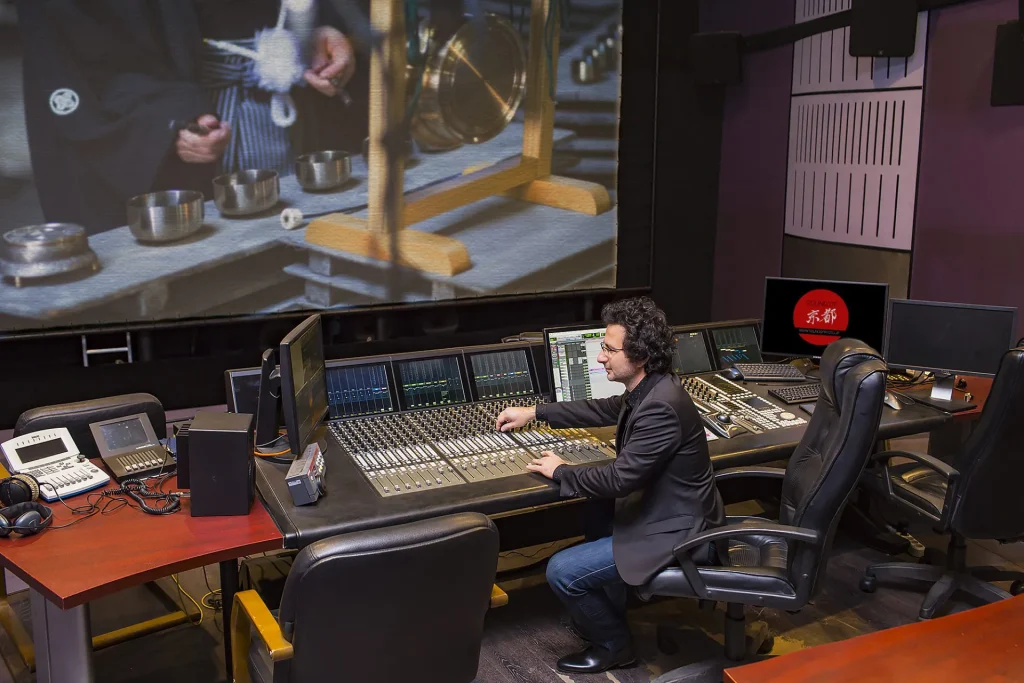




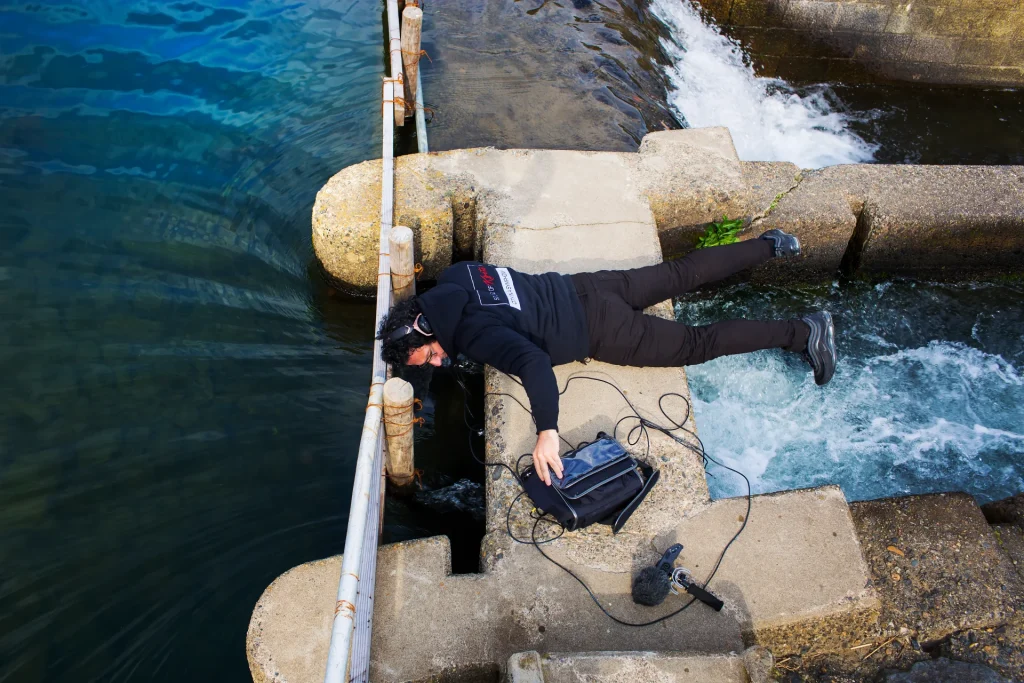
with subsequent studio processing of the recordings, 2018/19.


at Dolby Premier Studio (Atmos), 2017/18.
Polytope
Polytope designates the simultaneous or successive presentation of a work in multiple locations, which function together as a cohesive scenic and sonic field. In this context, the site itself becomes a constitutive medium of the work, expanding composition beyond the musical score to encompass space, architecture, and urban environments. A characteristic example is the series «Sound of», in which entire cities are musicalized and transformed into polytope environments.20
The polytope is not limited to site-specific performance, but rather articulates a structural principle of composition: the integration of multiple sites into a single coherent aesthetic field. It involves a spatial dramaturgy, where disparate locations interact as components of one polymedial whole. In this sense, the polytope transforms geography into musical form, allowing architecture, environment, and the audience’s site of reception to function as integrated parameters of composition.
From an art-historical perspective, this notion resonates with Iannis Xenakis’s Polytopes of the 1960s and 1970s, which combined sound, architecture, and light into large-scale multimedia spectacles. Yet Elia’s approach differs in its focus on the musicalization of real cities and urban topographies, situating the polytope not in abstract geometrical constructions, but in the cultural and social fabric of actual environments.21
This orientation situates the «Sound of» cycle within contemporary cultural-diplomacy discourse, where site-specific artistic interventions mediate civic identity and transnational exchange.22

Polyscience
Polyscience designates the creative convergence of scientific and artistic practices within a single compositional framework. A central example is Elia’s project «Sound of Ocean: SEAMPHONY», which combines oceanographic data and soundscapes of the sea with musical composition, addressing issues of sustainability within the framework of the Blue Economy.23, 24
In this context, scientific knowledge does not serve as background information but becomes a constitutive element of the work. Acoustic data, ecological parameters, and environmental recordings are integrated into a polymedial composition where science and art interact as equal partners. The resulting work is both aesthetic and epistemic, opening new spaces where art functions as a mode of knowledge.25
From a broader perspective, polyscience situates Elia’s practice within contemporary discourses on interdisciplinarity and art–science collaboration. By deliberately blurring the boundaries between creative and scientific inquiry, it functions not merely as a compositional method but as a cultural strategy, projecting a vision of music as a catalyst for new forms of knowledge and societal awareness.26


a study of the marine soundscape and its artistic, scientific, and ecological dimensions
(University of Trieste, Istituto Nazionale di Oceanografia e di Geofisica Sperimentale, 2023).
In this vein, the prototype guitar «Samurai» (2019–2025) offers a material–instrumental manifestation of polyscience: intercultural lutherie (double-shamisen «binomial soundbox»), historical geometry («Sangaku» problems and Pliny symmetry), reclaimed barrel woods that aged Santorini Assyrtiko, and laboratory acoustics (TUM, TUC, Vienna) co-determine the instrument’s morphology, resonance, and performative affordances. As part of «Sound of Kyoto», it shows how scientifically informed design and artistic intention can be methodologically fused so that material, visual, and sonic media become structural to a work’s identity — turning instrument-making itself into a site of knowledge production and cultural meaning.


References.
Click to open.
- «Marios Joannou Elia: The music of polymediality (VIDEO & PHOTO)». AlphaNews.Live, 14 Feb 2023. Accessed: 14 Feb 2023.
- «Interview with Marios Joannou Elia». Hellenic Institute of Cultural Diplomacy, 8 Apr 2023. Accessed: 3 Jul 2025.
- «Marios Joannou Elia: The Concept of Polymediality». Amazon.co.uk (Schott, 2017 listing). Accessed: 21 Apr 2025.
- Elia, Marios Joannou. «Music’s Incited ‘Augmented Reality’ in Xenakis’s Polytopes, Scriabin’s Mysterium and Polymediality». Bulletin of the Transilvania University of Braşov, Series VIII: Performing Arts, 21 Dec 2022, pp. 101–114. DOI: 10.31926/but.pa.2022.15.64.1.7. Accessed: 21 Apr 2025.
- «The Concept of Polymediality». Schott Music. Accessed: 21 Apr 2025.
- Schoon, Andi. «Noise as Spectacle: On the Plurimedial Compositions of Marios Joannou Elia». Neue Zeitschrift für Musik, 2014, 175(1), pp. 56–59. Accessed: 21 Apr 2025.
- «Music’s Incited ‘Augmented Reality’…». European Academy of Sciences and Arts – Library. Accessed: 3 Jul 2025.
- Elia, Marios Joannou. The Concept of Polymediality. Mainz: Schott Music, 2017, pp. 65–66. ISBN 978-3-95983-100-0. Online.
- Aristotle. De Anima (On the Soul). Trans. C. D. C. Reeve. Indianapolis: Hackett, 2015.
- Stein, Barry E., and M. Alex Meredith. The Merging of the Senses. Cambridge, MA: MIT Press, 1993.
- McLuhan, Marshall. Understanding Media: The Extensions of Man. Cambridge, MA: MIT Press, 1994 [orig. 1964].
- Schafer, R. Murray. The Soundscape: Our Sonic Environment and the Tuning of the World. Rochester, VT: Destiny Books, 1994 [orig. 1977].
- Schnittke, Alfred. «Polystylistic Tendencies in Modern Music». Soviet Music, 1971.
- Born, Georgina, and David Hesmondhalgh (eds.). Western Music and Its Others: Difference, Representation, and Appropriation in Music. Berkeley: University of California Press, 2000.
- Kramer, Jonathan D. «The Time of Music: New Meanings, New Temporalities, New Listening Strategies». New York: Schirmer, 1988.
- Bakhtin, Mikhail. «The Dialogic Imagination: Four Essays». Austin: University of Texas Press, 1981. (For the concept of the «chronotope».)
- Elia, Marios Joannou. «Comment to video: ‘Hundreds of hanging wooden plates are transformed into a sound sculpture, played by hand to create waves of earthy, resonant tones’». Facebook, 28 Apr 2024. Online.
- Xu, Iverson. «Sound of Shanghai: The Art and Technology of Spatial Audio Reproduction».
- Di Scipio, Agostino. «Sound is the Interface: From Interactive to Ecosystemic Signal Processing». Organised Sound, 8(3), 2003, pp. 269–277.
- Elia, Marios Joannou. «Das Konzept der Polymedialität am Beispiel von ‘Sound of Vladivostok’». European Academy of Sciences and Arts – Library, 2 Jun 2019. Accessed: 3 Jul 2025. Online.
- Kanach, Sharon. «Xenakis’s Polytopes: Architectures of Fire». Hillsdale, NY: Pendragon Press, 2012.
- Gienow-Hecht, Jessica C. E., and Mark C. Donfried (eds.). «Cultural Diplomacy: Beyond the National Interest?». New York: Berghahn Books, 2010.
- Isaias, Evagoras A. «Sound of Ocean – SEAMPHONY by Marios Joannou Elia». Academia.edu. Online.
- Isaias, Evagoras A. «SEAMPHONY: Sound of Ocean by Marios Joannou Elia». ResearchGate, National Institute of Oceanography and Applied Geophysics, Feb 2023. Online.
- Malina, Roger F. «Art-Science: Integrative Collaborations to Address Complex Problems». Leonardo (MIT Press), 2010.
- Szerszynski, Bronislaw. «The End of the Ocean: Science, Art, and Environmental Imagination». Nature and Culture, 5(2), 2010.
- Elia, Marios Joannou. «Zeitgenössische Musik im Kontext von Polyaesthetik und Polymedialität». Schott Campus. Online. Accessed: 24 Sep 2025.